

When you start a construction project in Albuquerque, you’ll quickly realize that commercial and government construction are two distinct processes. While commercial projects are driven by business timelines and private utility needs, government work is strictly bound by government construction compliance rules. Apart from the paperwork, Albuquerque also has unique site conditions, from high-desert drainage requirements to specific soil compaction standards, that dictate which methods you must use. You also need access to the right kind of help and builders to avoid any run-ins with the local construction regulatory standards.
Thus, to keep track of all these variables as you delve into your next project, we bring you this guide with everything you need to know in one place. Read ahead to make sure your next build stays compliant!
Key Takeaways
|
Construction in Albuquerque, NM: What “Local Conditions” Change
Regional climate considerations
People who live in Albuquerque know that the temperature can change from hot in the afternoon to cool at night on the same day. This city also has very different weather patterns from season to season. These conditions affect every part of the building process:
- Changes in temperature: Rapid changes in temperature need special ways to cure concrete and careful planning for how structural steel will expand.
- Strong winds in the spring mean that strict Erosion and Sediment Control (ESC) plans are needed.
- Monsoon Season: Heavy rain falls in short bursts, so you need good drainage plans.
Working with Albuquerque Soils
The ground in this city is tricky. Most of the area consists of loose, sandy soil that shifts easily and collapses if it gets too wet or too dry. To better understand why underground utility installation is crucial to building something that lasts, take a look at these tips recommended by builders in Albuquerque:
- The “95% Rule”: You must soak and pack the dirt (moisture conditioning) until it hits 95% density. If you skip this, your foundation or road will eventually sink or crack.
- Trench Safety: Because the “Type C” sandy soil doesn’t stick together, any trench deeper than 5 feet is prone to collapse. You must use metal shields, shoring, or cut the walls back at a wide angle (1.5:1 slope) to keep workers safe.
- Water Control: Water is the enemy of stability here. You have to keep rain and runoff out of your excavations, or the walls will turn to mush and cave in.
Utility coordination realities
You must have felt your frustrations rise while dealing with utilities in Albuquerque, because of its underground, congested network of old and active pipes. These are some issues you will likely have to face:
- Verifying Before You Dig: The blueprints of the city’s underground layout are highly outdated and unreliable. Thus, to be sure of where a particular line is, workers should use potholing through vacuuming tools to physically find and measure the depth of pipes and wires.
- Watching the Clock: Moving a major line, especially fiber-optic cable, can take months. If you don’t coordinate this at the very start, this process can end up delaying your project.
Once the work is done, you have 30 days to submit “as-built” maps, which are further verified by a licensed New Mexico surveyor.
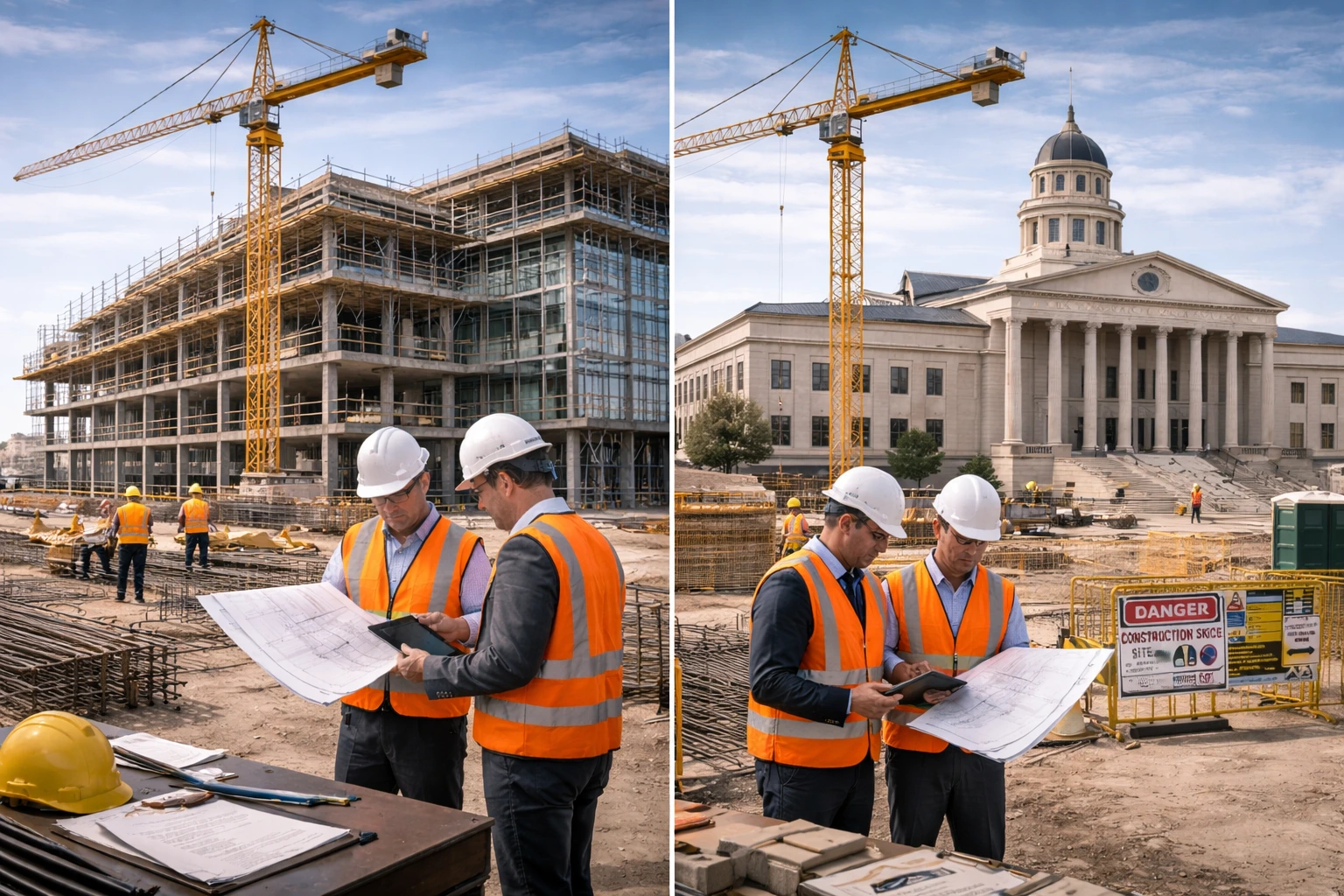
Commercial vs Government Construction in Albuquerque, NM
To get a better mental picture of the local differences between commercial and government construction, take a look at the table below:
Category |
Commercial Construction |
Government (Public / Federal) Construction |
Procurement & Bidding |
Direct negotiation or private competitive bids focused on speed and cost-efficiency. |
Formal RFP/IFB process under FAR or City Procurement rules; highly structured and documentation-heavy. |
Regulatory Compliance |
Must meet local codes plus federal requirements (Buy American Act, enhanced safety standards, cybersecurity compliance). |
|
Labor Wages |
Market-based wages. |
|
Timeline & Flexibility |
Faster decision-making and flexible scope changes. |
Rigid milestone schedules; change orders are tightly restricted and highly regulated. |
Inspections & Oversight |
City inspections under standard building codes. |
Additional federal or agency oversight, making inspections more rigorous. |
Environmental Review |
Standard local environmental and zoning compliance. |
More extensive and formally documented environmental assessments. |
Once you’ve locked in the project type, your first big move is choosing between design-build vs traditional build. This sets the DNA for the entire project, defining whether you’ll be managing technical disputes yourself or holding a single entity accountable for the final result.
Core Construction Service Categories
Site Preparation and Earthwork
- What It Includes: The team of workers handles clearing, grading, and cut/fill operations, alongside precise excavation and trenching for utilities. This includes backfill, subgrade prep for stable building pads, and strict dust and erosion control.
- Albuquerque-Specific Considerations: To account for the monsoon runoff, advanced drainage planning is used. The major focus is on moisture-conditioned compaction and mandatory density testing to prevent the ground from sinking and loose dust from blowing.
Structural Construction and Building Systems
- Core Scope: This phase starts with reinforced foundations and slabs to transfer loads to the subgrade, followed by structural framing (steel, masonry, or wood) for the building’s primary skeleton. Workers then install the building envelope, consisting of walls, roofing, and moisture barriers, to create a weather-tight seal for final interior build-outs.
- This is how builders handle performance factors:
- Thermal Efficiency: Using high-thermal-mass materials to stop energy loss during 40-degree daily temperature swings.
- UV/Weather Protection: Installing specialized barriers to defend against high-altitude UV and wind-driven dust.
- Structural Integrity: Engineering-specific bracing and seals for extreme seasonal variations.
Underground Utility Systems
- Water, Sewer, and Storm: Installation involves distribution lines and sanitary systems using slope-accurate trenching to ensure consistent gravity flow. Runoff management utilizes inlets, culverts, and detention systems engineered to meet the city’s municipal flood standards.
- Gas Infrastructure: In both commercial and government construction, the crews lay Polyethylene (PE) and steel piping for main-line gas distribution. This includes the installation of regulator stations, master meters, and pressure-rated valves that are compliant with safety standards to avoid common failures in commercial gas piping systems.
Commercial Utility Installation and Repair
- Active Facility Maintenance: Crew members repair and install valves, pumps, and controls with minimal disruption. This includes specialized backflow prevention on commercial properties to protect your facility from cross-contamination with the municipal supply. Plus, for active upgrades, they also use hot taps and bypassing to keep your business running during construction.
- Infrastructure Rehabilitation: Failing pipelines are replaced using pipe bursting to swap cast iron or steel for modern materials with minimal excavation. In high-traffic or tight urban corridors, trenchless re-lining and directional drilling are used to restore or install infrastructure where open-cut trenching is not feasible.
Mechanical, Piping, and Gas Systems
- Structural Integrity & Flow: Installation of mechanical piping designed for high-pressure conditions, incorporating regulators and components for facility fluid and energy distribution.
- Verification Protocol: Every installation in commercial and government construction undergoes strict pressure testing to verify seal integrity, documentation of welding records for compliance, and safety inspections at every milestone.
Concrete Work
- Common Applications: The team pours 4,000 PSI foundations, structural slabs, and site flatwork engineered for heavy equipment and local silt loads.
- Performance Factors: To prevent “flash setting” and “map cracking,” we use strategic jointing and chemical curing agents that withstand Albuquerque’s extreme heat and 40-degree temperature swings.
- Quality Controls: We enforce mandatory 95% Proctor density testing on subgrades and utilize air-entrained mix designs to survive winter freeze-thaw cycles.
If you want to better streamline large-scale commercial construction projects, commercial construction with HCSS HeavyJob Software will help you with real-time tracking and management.
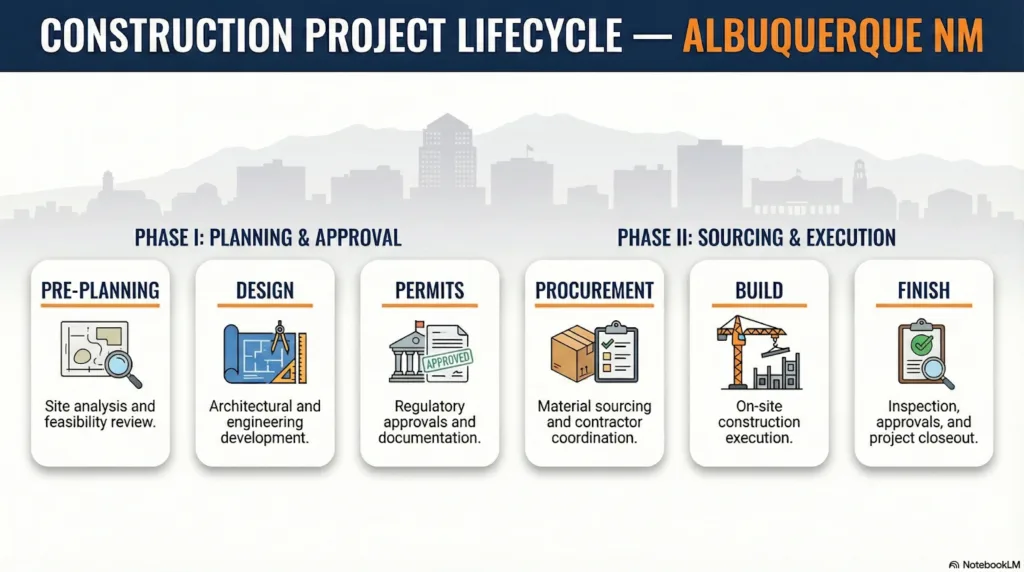
What Are The Major Steps In A Construction Project In Albuquerque?
Government Construction in Albuquerque, NM
What Government Work Typically Covers Locally
- Public Infrastructure and Utility Upgrades: Maintenance of roadways and the installation of traffic signals and streetlights. This includes accessibility improvements like sidewalks, ADA-compliant ramps, and bike lanes to enhance city-wide mobility.
- Facility Upgrades for Public Buildings: Modernizing older public structures to improve comfort and sustainability. Key tasks involve installing solar energy systems, LED lighting, and updating aging mechanical, electrical, and plumbing (MEP) systems.
- Right-of-Way and Corridor-Adjacent Construction: Managing infrastructure changes that occur between private property lines. These projects focus on the Public Right-of-Way (ROW) to ensure seamless transitions between private developments and public corridors.
- Agency-Driven Site Remediation or Improvement Work: Projects led by public agencies to facilitate regional redevelopment. This includes critical work such as flood control, habitat restoration, and wildfire mitigation to protect the local environment.
Procurement and Compliance For Transparency
To ensure strict government construction compliance, Albuquerque construction follows strict city ordinances and state procurement codes:
- Competitive Bidding Norms: Projects are awarded to the lowest responsible bidder via sealed bids or qualification-based RFPs. Contractors must provide 5% bid security and 100% Performance and Payment Bonds.
- Documentation and Submittal Expectations: Bids must use the city’s e-Procurement System. Change orders are capped at 35% and require rigorous justification for unforeseen conditions.
- Solid supply chain management strategies ensure lead times and vendor vetting are handled months in advance. This prevents ‘last-minute’ material substitutions that could fail inspections later.
Local Stakeholders and Jurisdiction Layers You Must Keep In Mind
There is a very delicate balance that you’ll need to find between the varying needs of the city, county, and federal jurisdictions. This will become clearer when you read the following:
- City-Level Requirements: Inside city limits, the Integrated Development Ordinance (IDO) is your rulebook. You’ll work with the DMD for street access and Building Safety for electrical or plumbing permits. Also, remember that any major infrastructure or site plans must first pass through the Development Review Board (DRB).
- County-Level Involvement: When working on the city’s edge or in unincorporated areas, Bernalillo County Planning takes the lead on zoning. Regardless of location, the ABCWUA must sign off on all water and sewer connections to ensure the regional grid can handle the new load.
- State and Federal Overlays: If the project involves state highways or federal money, the stakes get higher. NMDOT sets the standards for roads and bridges, while the EPA and Army Corps of Engineers (USACE) enforce environmental and stormwater protections to keep the project compliant with federal law.
Safety, Quality, and Regulatory Rules in Albuquerque, NM
Topics about safety
When you build in Albuquerque, prioritising crew safety is your best defense against the various construction regulatory rules. You need to remember these important things:
- The Basics of OSHA Compliance: Make sure that workers have 10-hour OSHA certifications and supervisors have 30-hour certifications. To avoid NMED fines of more than $16,000 for each violation, make sure you follow the rules for Fall Protection and Excavation.
- Site-Specific Safety Plans (SSSP): You need a plan that shows the specific dangers on your site, like deep trenches or things that could fall on you from above. Include emergency routes that are specific to your area and fire safety rules.
- Preventing Incidents: Set up a system for reporting “near-misses” right away to stop more accidents from happening. Make sure that daily inspections and standard PPE, like hard hats and safety glasses, are always followed.
Topics about quality
Keep these things in mind to make sure your work in commercial and government construction is always up to the local code:
- QA/QC Plans: You need to make a three-step control process that includes having planning meetings, doing initial inspections, and checking in on a regular basis. Use Non-Conformance Reports (NCR) right away to fix problems before they get too big and costly to fix.
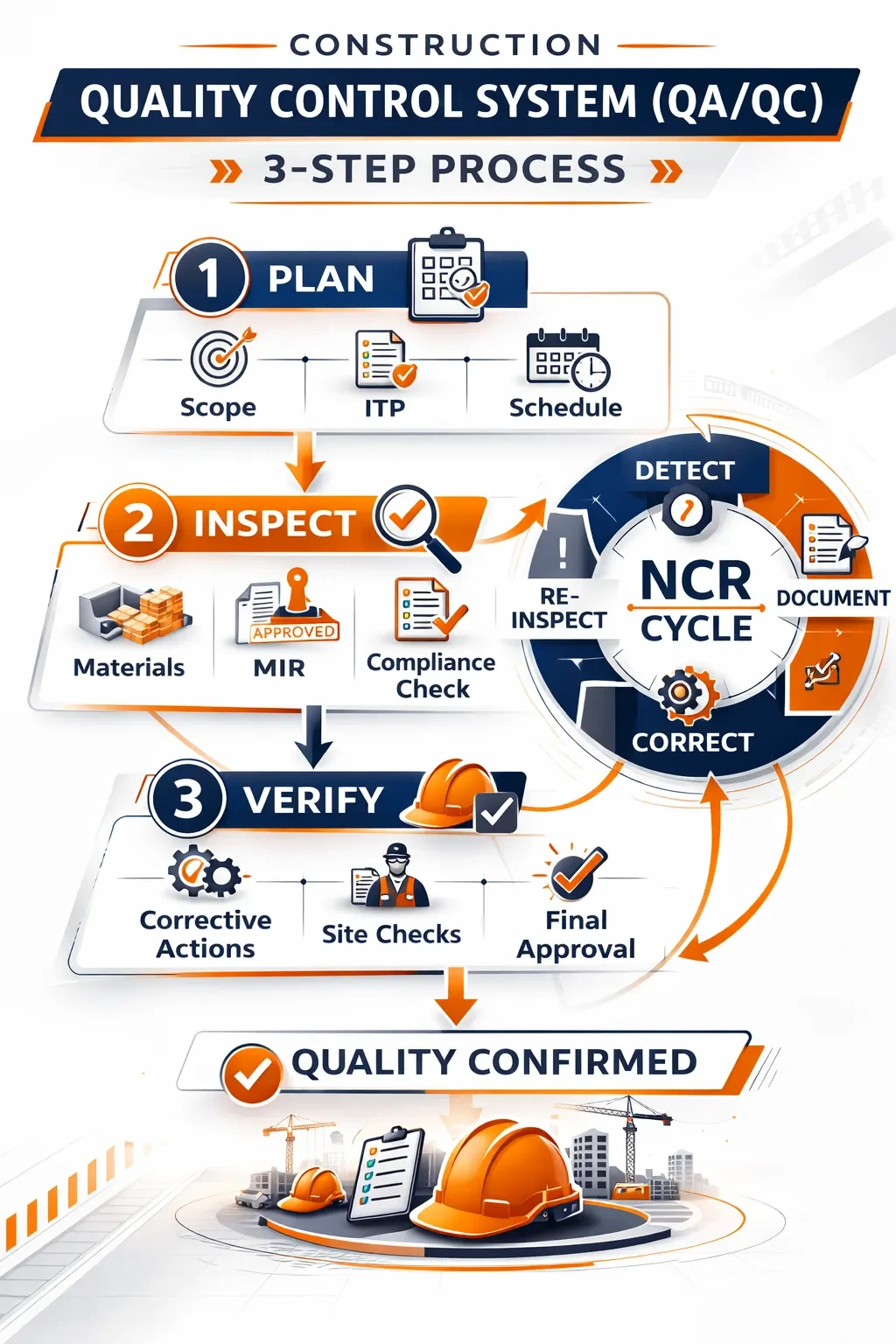
- Testing Records: You need an Inspection and Test Plan (ITP) that outlines how often samples will be taken and what qualifications the testers must have. Keep your daily Site Observation Reports (SOR) up to date so that you can keep track of all the tests.
- Use Material Inspection Requests (MIR) to check and verify all deliveries before they are made. You can also put parts together somewhere else. Even though prefabrication has its pros and cons in modern construction, it helps keep quality standards high by keeping the site clean.
Layer of Local Compliance
Lastly, you need to get through the local compliance layer to avoid expensive shutdowns in commercial and government construction:
- Requirements for a permit: You need permits that have been approved for everything from solar panels and roofs to walls that are more than 6 feet high. Before you start building, send the Building Safety Division detailed plans for review.
- Public Safety and Access: for safety reasons, it’s best to secure areas near schools and businesses, and keep strict records of safety and injury prevention to minimize chances of accidents occurring in these city-owned or adjacent spaces.
- ROW and Traffic Control: Get Excavation/Barricade permits for any work that will affect public streets. To keep traffic moving safely, you must follow Manual on Uniform Traffic Control Devices (MUTCD) rules.
Requirements for Certifications and Eligibility for Public Projects
To show that you can handle a public project, you need to check these boxes:
- Bonding and Insurance: You usually need a bond of at least $10,000, and you must be registered as an official city vendor.
- Safety of the workforce: You have to show that your team has been trained for specialized tasks such as scaffolding, crane operation, or confined space entry through certifications.
- Small Business Administration (SBA) Programs: If you own a small, local, or disadvantaged business, you can get “set-aside” preferences that give you a better chance of winning the bid.
- Audit Readiness: Because you’re using money from taxpayers, your records (like receipts, payroll, and safety logs) need to be ready for a city inspection at any time.
Why This Is Important
- Guaranteed Results: Bonding is like an insurance policy for the city; if a contractor doesn’t finish the work, the city doesn’t lose any money.
- Fair Play: These rules make sure that all businesses follow the same safety and legal rules, and the city is assured that you have the finances to handle the expenditure load without risking bankruptcy.
Conclusion
Now that you’ve reached the end of this detailed guide, you know that commercial and government construction projects don’t become successful just at the ribbon-cutting. Instead, you need builders who can actually follow construction KPIs to improve project profitability. That is where we at DUB-L-EE come in! Our team has been delivering commercial and government projects since 2012, including work for NASA and the Santa Fe Opera Community.
So, are you ready to move your next Albuquerque project forward with our expertise? Contact us today to get started!
FAQs
How does permitting typically work for commercial construction in Albuquerque?
You submit plans through the online ABQ-PLAN portal; they are reviewed by zoning, fire, and building departments simultaneously (usually taking 3–12 weeks), and once approved, you pay fees to get your permit.
What’s different about government construction documentation in New Mexico projects?
For public projects or those valued over $600,000, New Mexico requires “Multiple Seals,” meaning both a registered architect and a professional engineer must officially stamp the plans.
What causes delays most often in Albuquerque construction projects?
Delays are typically caused by skilled labor shortages, lengthy permit approval cycles, and unforeseen site conditions like hitting unmapped utility lines in older parts of the city.
When is trenchless utility work preferred in Albuquerque?
It is preferred when installing lines under major roads (like Central Ave), existing buildings, or historic areas where digging an open trench would be too expensive or cause too much traffic disruption.
What inspection documentation is typically required for public projects?
You must maintain a “plans-on-site” log, daily activity reports, material testing results, and signed-off Inspection Request Forms for every major phase to prove the work matches the city-approved design.
