
The construction industry has long been characterized by traditional methods and manual processes. However, as the projects grow in complexity, scope, and scale, these outdated approaches are no longer sufficient to meet the increasing demands for faster delivery, tighter budgets, and higher-quality outcomes. In response, construction project management is undergoing a significant transformation, driven by the integration of advanced technologies.
But the questions that arise are: what specific technologies are enabling this shift? And how are they revolutionizing the way construction projects are managed from the ground up? That’s exactly what we’ll explore in this blog post. Let’s dive right in.
Technology-Driven Transformation In Construction ManagementAdvanced technologies are reshaping construction project management by improving communication, visibility, and risk control. Tools like BIM enable precise planning and clash detection, while cloud platforms centralize data and enhance collaboration. AI and machine learning support predictive insights and scheduling, while mobile apps streamline field operations. IoT devices provide real-time monitoring for safety and efficiency. Together, these innovations reduce errors, control costs, boost productivity, and ensure higher-quality project outcomes overall. |
Why Technology Matters in Construction Project Management
Technology has become an essential part of modern construction project management, transforming how projects are planned, executed, and delivered by introducing smarter systems, better coordination methods, and improved overall project outcomes.
Communication and Collaboration
Modern construction projects require seamless coordination between architects, engineers, contractors, subcontractors, and clients. Technology facilitates this coordination through cloud-based platforms that provide real-time access to project information, drawings, and specifications. Team members can collaborate effectively regardless of their physical location, reducing delays caused by miscommunication or information silos.
Digital collaboration tools also create comprehensive audit trails that document decisions, changes, and approvals throughout the project lifecycle. This transparency is one of the key components of effective commercial construction risk management, as it improves accountability and helps resolve disputes more efficiently when they arise.
Improved Project Visibility and Control
Traditional project management often relies on periodic reports and manual updates, creating information gaps that can lead to costly surprises. Technology provides continuous monitoring capabilities that give project managers real-time visibility into schedule progress, budget performance, and resource utilization. To measure and manage this effectively, many leading firms rely on top construction KPIs To Improve Project Profitability. Tracking the right metrics can significantly improve profitability and efficiency.
Advanced dashboard systems aggregate data from multiple sources to present comprehensive project status information in easily digestible formats. This enhanced visibility enables proactive problem-solving and more informed decision-making throughout the project lifecycle.
Risk Mitigation and Quality Assurance
Construction projects face numerous risks, from weather delays to material shortages to safety incidents. Technology helps identify and mitigate these risks through predictive analytics, automated monitoring systems, and comprehensive documentation processes.
Integrated digital systems play a crucial role in risk management in the construction industry by ensuring the consistent application of standards and procedures across all project stages. They also generate detailed records for compliance, quality assurance, and warranty documentation. These systems reduce the likelihood of defects and rework, ultimately improving project profitability and client satisfaction.
Key Technologies Reshaping Construction Management
Key technologies are transforming construction management by changing how projects are planned, executed, and delivered. By enabling more efficient workflows, stronger coordination, and smarter decision-making across the entire construction process overall.
Building Information Modeling (BIM)
BIM represents one of the most significant technological advances in construction project management. This technology creates detailed digital representations of physical and functional characteristics of buildings, enabling comprehensive project visualization before construction begins and serving as a central tool within a construction project management plan.
BIM facilitates clash detection, allowing teams to identify and resolve conflicts between different building systems during the design phase rather than during construction. This capability significantly reduces change orders, delays, and cost overruns. Additionally, BIM supports accurate quantity takeoffs and cost estimation, improving budget accuracy and procurement planning.
The collaborative nature of BIM ensures all project stakeholders work from the same information model, reducing errors and miscommunication. As projects progress, BIM models can be updated to reflect actual conditions, creating valuable as-built documentation for facility management.
Cloud-Based Project Management Platforms
Cloud technology has revolutionized how construction teams access and share project information. Modern cloud-based platforms provide centralized repositories for all project documents, communications, and data, accessible from any device with internet connectivity.
These platforms support mobile workflows that enable field personnel to update project status, submit reports, and access critical information without returning to the office. Real-time synchronization ensures all team members work with current information, reducing errors and improving coordination. A prime example of this advancement can be seen in how teams are optimizing commercial construction with HCSS HeavyJob Software. Purpose-built for the demands of commercial construction, this platform streamlines field operations, increases productivity, and enables more accurate job costing and performance tracking.
Cloud platforms also facilitate better document control through version management, automated approval workflows, and comprehensive access controls. This capability is particularly valuable for large projects with multiple stakeholders requiring different levels of access to project information and ensures that every aspect of the construction project management plan is easily trackable and up-to-date.
Artificial Intelligence and Machine Learning
AI and machine learning technologies are beginning to transform construction project management through predictive analytics, automated scheduling, and intelligent resource optimization. These systems analyze historical project data to identify patterns and predict potential issues before they occur , supporting effective risk management in the construction industry.
Machine learning algorithms can optimize project schedules by analyzing resource constraints, weather patterns, and historical performance data. This capability helps project managers develop more realistic timelines and identify critical path activities that require special attention.
AI-powered systems also support automated progress monitoring through image analysis and sensor data interpretation. These capabilities reduce the manual effort required for progress reporting while providing more accurate and objective assessments of project status.
Mobile Technology and Field Applications
Mobile devices and specialized field applications have transformed how construction teams capture and share information from job sites. Modern mobile applications support digital forms, photo documentation, and real-time communication, reducing paperwork and improving information accuracy.
Field personnel can now complete inspections, submit daily reports, and track time and materials using mobile devices. This information automatically integrates with project management systems, providing real-time updates on project progress and resource consumption.
Mobile technology also supports better safety management through digital safety checklists, incident reporting capabilities, and emergency communication systems. These tools help ensure consistent application of safety procedures while creating comprehensive records for compliance purposes, which are essential components of an effective construction project management plan.
Internet of Things (IoT) and Sensor Technology
IoT devices and sensors provide continuous monitoring capabilities that enhance safety, security, and operational efficiency on construction sites. Environmental sensors track temperature, humidity, and air quality, ensuring optimal working conditions and contributing to proactive risk management in the construction industry.
Equipment sensors track usage, maintenance needs, and location, supporting better asset management and utilization optimization. These systems can automatically generate maintenance alerts and provide data for equipment lifecycle management decisions.
Wearable IoT devices enhance worker safety by monitoring vital signs, detecting falls, and tracking exposure to hazardous conditions. This technology enables rapid response to emergencies while providing data to improve overall safety programs.
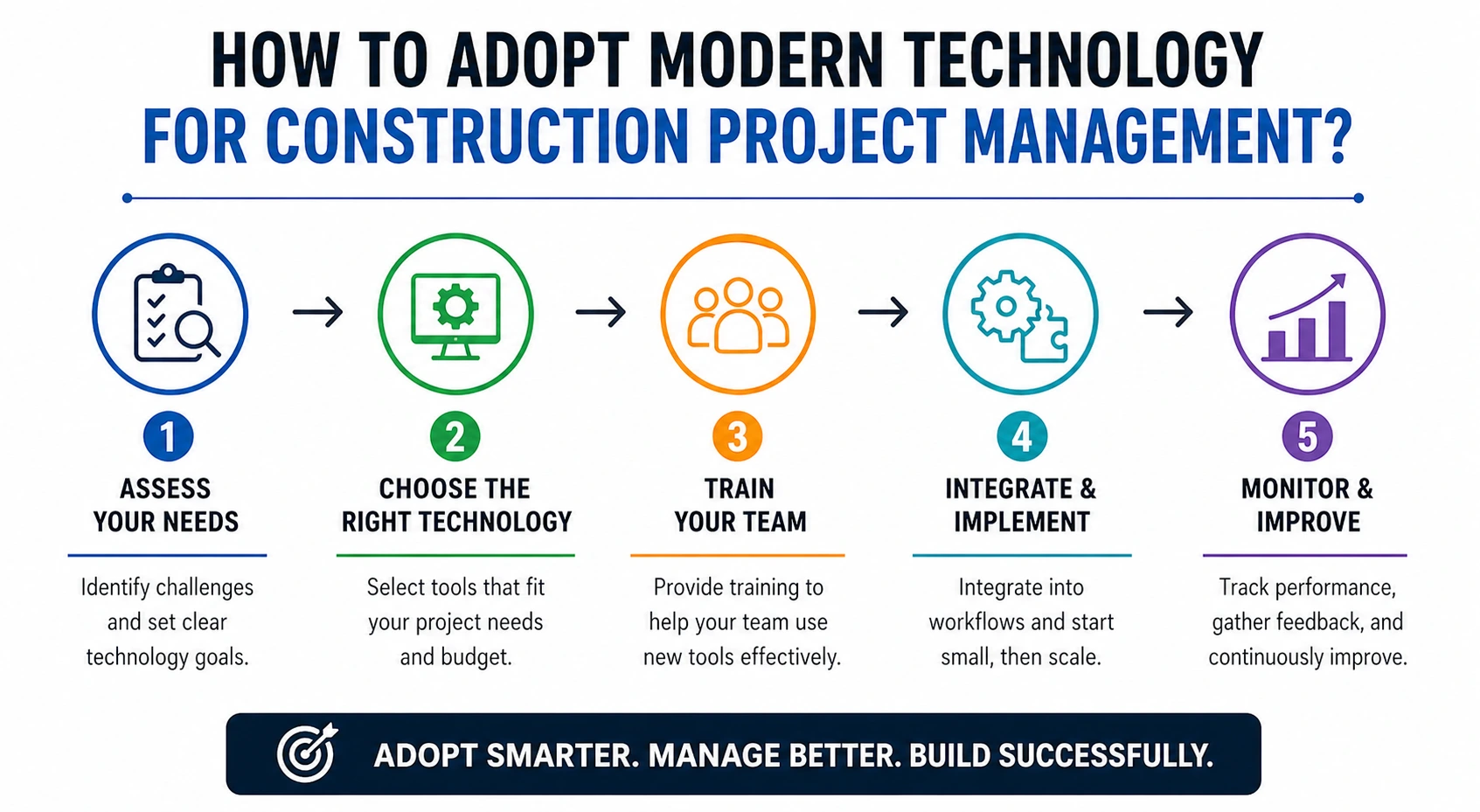
How To Adopt Modern Technology For Construction Project Management?
Adopting modern technology in construction project management requires a strategic approach that focuses on evaluating needs, selecting suitable digital tools, training teams, and gradually integrating systems to improve overall efficiency and outcomes.
To Wrap Up
If you’re getting construction done, or involved in construction work, renovation, or demolition, it’s important to understand the advantages that come with integrating technologies like BIM for better planning, AI for smarter decision-making, and IoT for real-time monitoring. Together, they not only improve efficiency but also help minimize common mistakes committed in commercial construction building codes, making compliance easier and more efficient.
As these tools continue to evolve, so too will their ability to enhance project outcomes. The firms that invest in scalable solutions and prioritize team training will be best positioned to succeed in the future.
Build smarter with Dub-l-ee, faster projects, fewer errors, total control, and next-level construction efficiency from start to finish.
FAQ’s
How does digital documentation improve construction workflows?
Digital documentation helps keep all project information in one place, reduces paperwork, avoids confusion, and lets everyone quickly find and use the latest updated files easily.
What role does automation play in construction management?
Automation does repeated work, like reports and schedules, automatically. It saves time, reduces mistakes, and lets workers focus on more important construction tasks.
How does technology contribute to safer construction sites?
Technology helps keep workers safe by spotting dangers early. It uses devices to monitor conditions and workers, send warnings quickly, and prevent accidents on construction sites.
Is construction technology only useful during the building phase?
No, it is useful in all stages, planning, building, and after construction. It also helps in maintenance and managing the project better for a long time.
How does technology reduce project delays?
Technology helps avoid delays by keeping everyone updated, showing progress clearly, and quickly fixing problems before they slow down the construction work.
How does technology improve teamwork in construction projects?
Technology helps teams work better together by sharing updates quickly, keeping everyone informed, and making communication easy, even when people are in different places.