
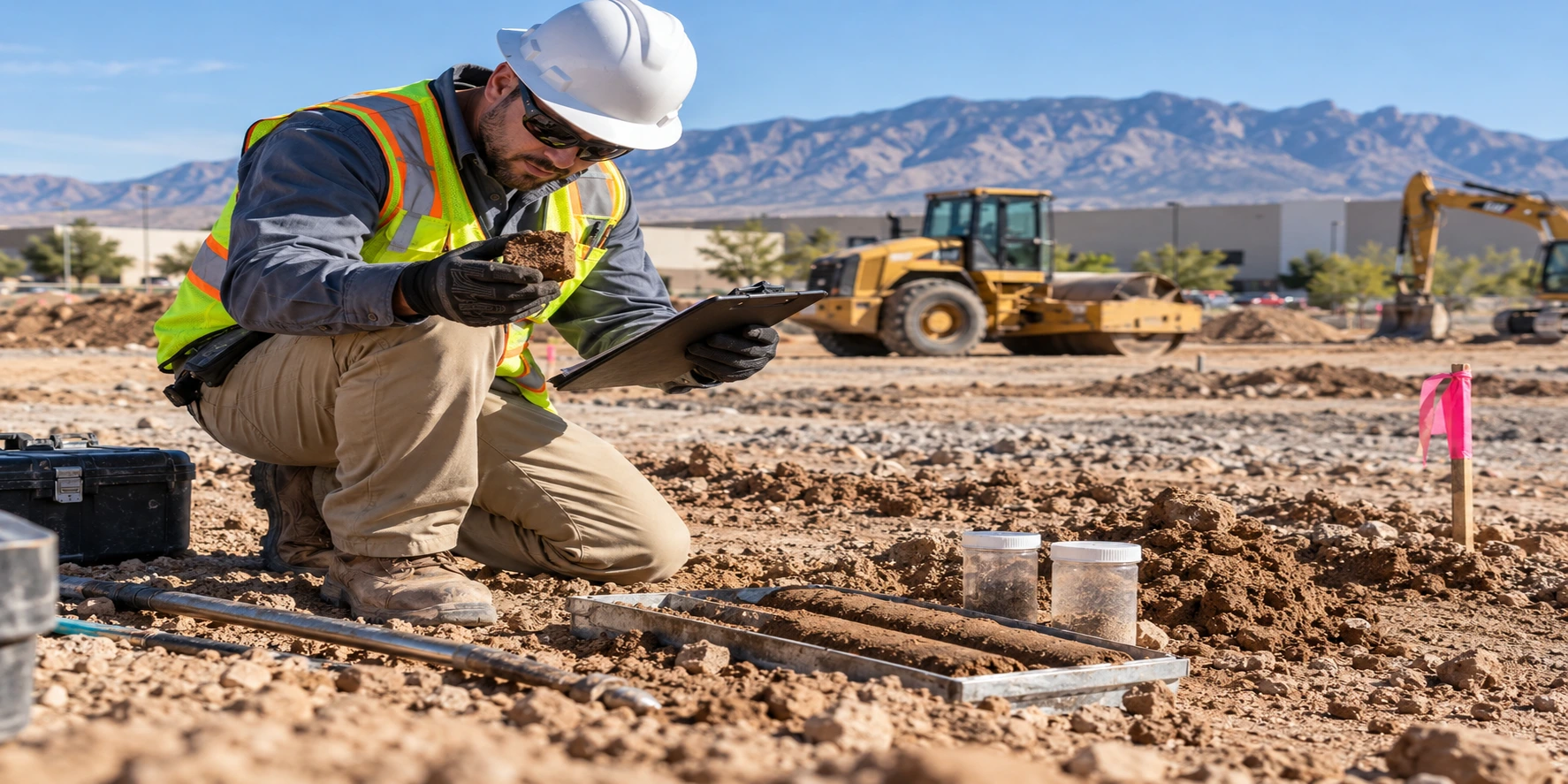
Every commercial site looks solid on the surface, but what’s underneath is what actually determines whether a foundation holds, a slab stays level, or a parking lot cracks apart within a few winters. That’s the entire point of soil testing for construction; it takes the guesswork out of what the ground can actually support before a single truckload of fill ever gets dumped. Skipping this step doesn’t save time so much as it defers a problem to a much more expensive stage of the project, often after concrete has already been poured. Understanding what this testing actually tells you, and why it has to happen before fill and compaction begin, makes it easier to see why experienced contractors treat it as non-negotiable.
Soil Testing During Construction OverviewReliable construction starts below ground, not above it. Soil testing for construction removes guesswork by revealing compaction levels, moisture content, load-bearing capacity, and risky soil types like expansive clay before fill work begins. Only trained soil professionals should perform this evaluation, since it directly determines foundation type and site preparation needs. Skipping it removes the moisture targets, compaction benchmarks, and accountability crews rely on, often surfacing later as cracks, sinking, or standing water. Engineers convert lab results into layer-by-layer compaction instructions, checked and verified at every stage before construction proceeds. |
Why Soil Testing Work Belongs to Trained Soil Professionals
Reading what’s underneath a site correctly takes more than a quick look at the surface; it takes a trained soil professional who knows exactly what to check for and how to interpret it. This isn’t a step a general crew can eyeball accurately; the margin for error here is exactly what separates a foundation that holds for decades from one that starts cracking within a few seasons.
- Checking how tightly packed and how wet the soil is, since both directly affect how much weight it can safely hold.
- Testing how much load the ground can bear at different depths, which tells engineers if extra support is needed before building.
- Finding the right moisture level for compacting the soil, so crews know exactly how wet or dry it needs to be to pack down properly.
- Checking for risky soil types, like clay that expands and shifts, or loose, waterlogged ground that can settle unpredictably.
These findings, gathered through soil testing for construction, shape decisions that are difficult and costly to reverse later, from the type of foundation an engineer specifies to whether the site needs extra preparation before construction can safely move forward. This groundwork matters just as much once utilities enter the picture, since underground utility installation is crucial to get right the first time, and it depends entirely on knowing what the soil around those lines can actually support.
| Cracked slabs and sinking foundations start with skipped soil testing. Talk to a team that verifies every layer before it’s covered, so problems get caught, not buried. |
The Cost of Skipping Professional Testing Before Fill and Compaction
Fill and compaction work is only as good as the information behind it, and that information only holds up if it came from someone qualified to gather it. Skipping the professional step doesn’t just remove a formality but also removes the specific data a crew actually needs to do the work correctly.
- No reliable moisture target, leaving the crew guessing at how much water to add before packing the soil down.
- No way to gauge compactive effort, since there’s nothing to measure each layer against as it’s placed.
- No verification before building continues, so problems that could have been caught in one layer simply get buried under the next.
- No professional accountability: if something fails later, there’s no qualified assessment on record to point back to.
This is exactly why testing has to happen before crews start moving fill rather than being treated as paperwork to finish afterward. Our breakdown of poor soil compaction consequences goes further into how these small shortcuts compound into major structural and financial setbacks, often traced back to a step a licensed professional was never brought in to verify. It’s also one of the most common excavation mistakes in commercial projects: crews move forward on assumptions instead of data, and that single shortcut tends to be the root cause behind many other common excavation mistakes that surface later in the build.
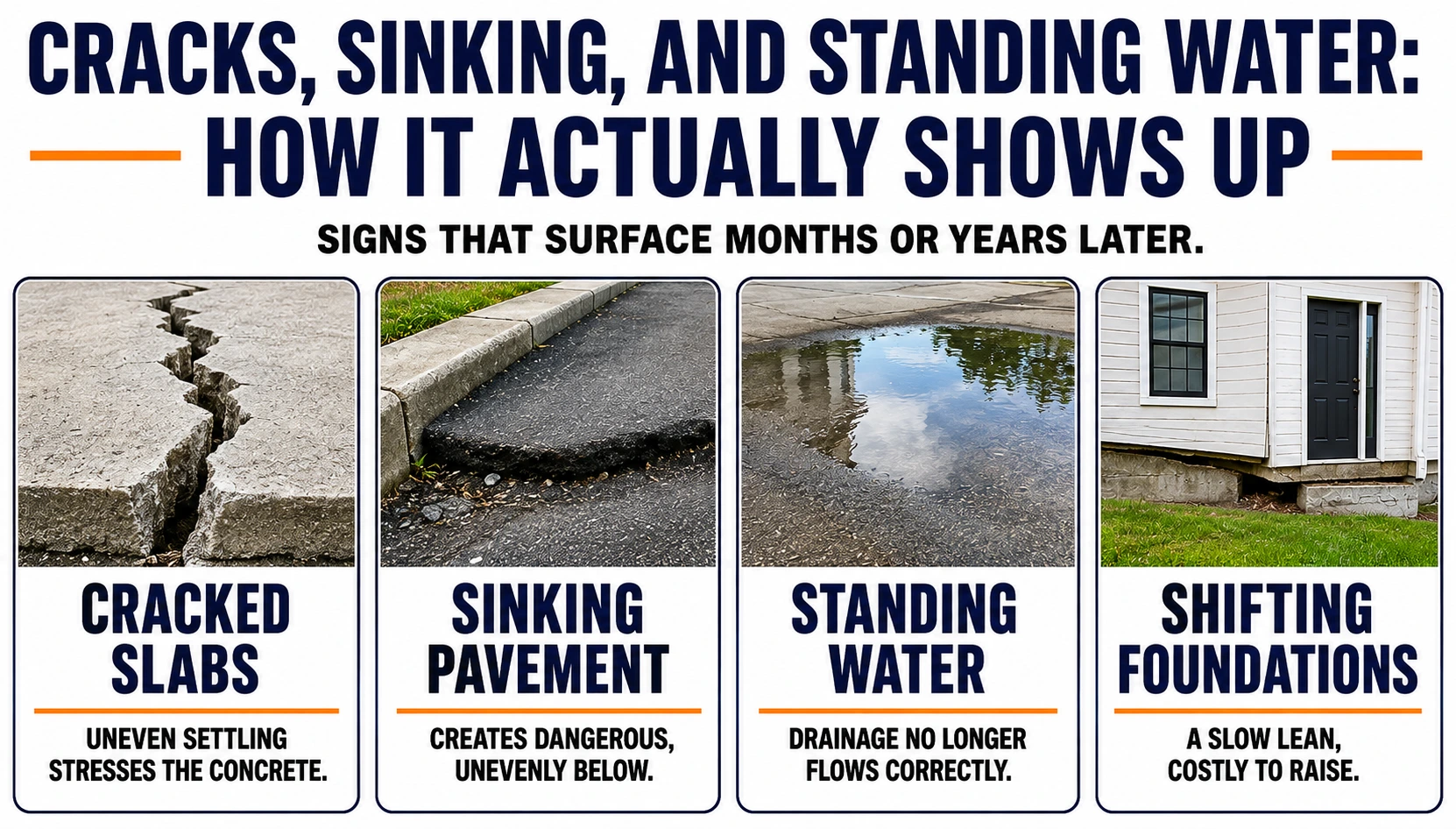
Cracks, Sinking, and Standing Water: How It Actually Shows Up
None of this damage shows up on move-in day; it takes months or seasons of settling before the ground reveals what was actually beneath it. By the time cracks or standing water appear, the fix usually costs far more than the testing that would have caught it early. The visual below shows exactly where that damage tends to surface first. Standing water in particular is often a sign of a deeper drainage gap, which is part of why commercial property needs storm piping designed around actual site conditions rather than a generic layout.
How Engineers Turn Test Results Into a Plan Crews Can Follow
Once a soil sample has gone through soil testing for construction, the results stop being numbers on a report and start functioning as clear instructions an engineer hands off to the crew doing the actual compacting. Lab results identify the exact moisture level a soil needs to pack down as tightly as possible, and most commercial projects set a required strength target that the finished ground has to reach before work can continue. Getting this right early also protects the rest of the schedule; coordinating with commercial utility contractors is far easier once compaction is confirmed and documented than after trenching has already started nearby.
- Soil is added and packed down in measured layers, rather than all at once.
- Water is added or allowed to dry out to match the target identified in testing, since soil that’s too wet or too dry won’t pack down properly no matter how much effort goes into it.
- Each layer is checked on site before the next one goes down, so problems get caught immediately instead of after everything is already covered up.
This is the practical value of soil analysis for construction: it turns compaction from a guessing game into a documented, repeatable process that inspectors and engineers can verify at every stage rather than trusting it by eye.
Conclusion
Soil testing isn’t a delay tactic; it’s the difference between a site that performs for decades and one that fails within a few seasons. For commercial projects where fill and compaction accuracy can’t be left to chance, working with a contractor who self-performs engineered fill and compaction, like Dub-L-EE, means moisture conditioning and density testing happen under one accountable team rather than being outsourced piecemeal. That kind of integrated approach is what keeps foundations solid long after the crews leave.
|
Don’t let unstable ground jeopardize your build. Get a professional assessment before fill and compaction work begins, and know exactly what your site can support. |
Common Questions About Soil Testing Before Construction
How long does soil testing typically add to a project timeline?
Usually a few days to about two weeks, depending on site size and how many samples are needed, far less time than a compaction failure would cost later.
Does the same soil report matter for underground utility work too?
Yes, underground utility installation depends on knowing the same ground conditions documented during testing, since trench stability and groundwater risk are tied to the same data.
Does every commercial site actually need soil testing?
Larger structures, sites with drainage history, or ground near slopes almost always need it, and even straightforward sites benefit from a baseline round of soil testing for construction.
Who typically pays for soil testing on a commercial project?
This is usually part of the pre-construction budget, covered by the property owner or developer, alongside other early site work like surveying.
Can this data help avoid excavation problems later on?
Yes, crews use the same soil profile to avoid common excavation mistakes tied to misjudging how stable the ground actually is once a trench several feet deep is opened and a different layer is exposed underneath.
What happens if fill and compaction don’t meet the required standard?
The affected area typically has to be reworked, sometimes removed and replaced, which costs far more than getting it right the first time.
Does soil testing affect drainage and site paving decisions as well?
Yes, drainage designers rely on the same data to size and route storm piping, since improperly accounted-for soil movement can shift a pipe out of grade within a few seasons.
Can construction start before all the soil test results are finalized?
Some early site work can proceed, but foundation and heavy fill work should wait, since building on unconfirmed ground risks having to undo it later.
Getting soil testing for new construction right at the outset isn’t about adding an extra step to your timeline; it’s what keeps every later phase of the project working from information the whole team can trust. If you’re planning a commercial project in the Albuquerque area and want a team that treats site preparation with the seriousness it deserves, reach out to discuss how soil testing for construction and proper compaction can protect your build from the ground up.