
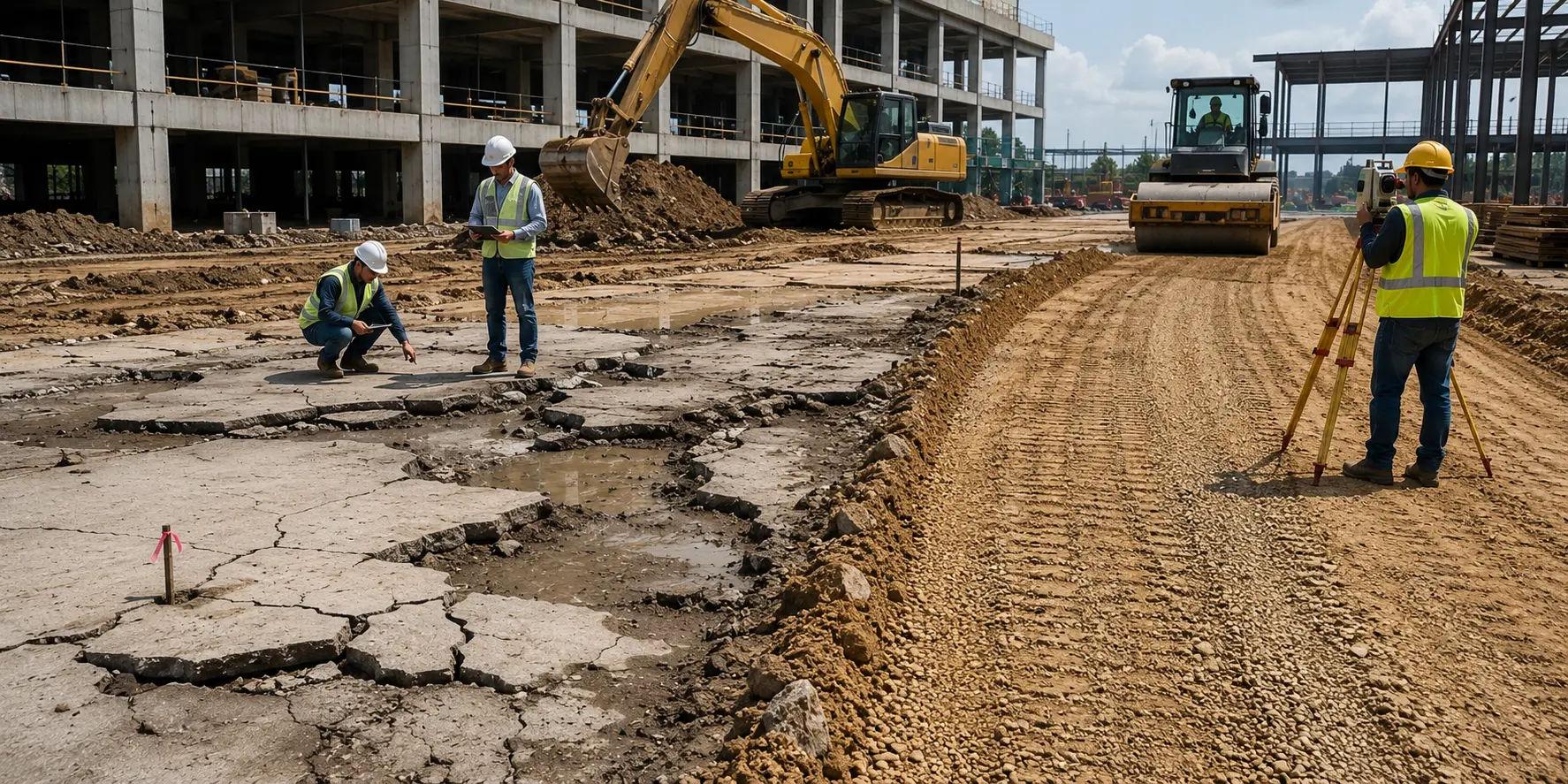
Even the most well-planned commercial construction projects can fail if the ground beneath them isn’t properly prepared. One common reason behind this is inadequate soil compaction: a critical step that involves the mechanical densification of soil to form a firm foundation that will support structures.
Poorly compacted soil may not exhibit any signs of failure immediately; rather, such signs emerge gradually: a microscopic crack on the concrete surface, a door that cannot be shut, or an area of road surface beginning to sink.
In this blog, we break down the very causes behind these consequences of poor soil compaction and the right approach to preventing it, so you know exactly what to watch out for on your next commercial project!
Understanding Uneven Soil Compaction in Commercial BuildsPoor soil compaction in commercial construction occurs when soil isn’t adequately densified before building begins. Common causes include incorrect equipment, improper moisture levels, and insufficient compaction passes. Over time, this leads to foundation settlement, slab failure, drainage issues, and costly legal liability. Prevention starts with proper site investigation, layered compaction, and verified density testing throughout the process. |
What Does Soil Compaction Mean?
Picture the soil as a sponge packed with tiny air pockets. On its own, those gaps keep the ground soft, unstable, and likely to shift the moment any real pressure is applied. Soil compaction is the process of closing those gaps, pressing the particles together until the ground is dense and solid enough to actually hold what’s being built on top of it.
What does it do?
Once those air pockets collapse and the particles lock into place, the ground transforms. It ceases to be a flexible material that is hard to predict and begins to behave like a stable foundation for other building materials, such as foundations, slabs, and pavements. It offers resistance to movement, distributes loads evenly on the surface, and maintains its shape. On top of all that, it avoids any future problems associated with uneven settling and moisture intrusion.
Causes of Poor Soil Compaction
Poor soil compaction is usually the result of improper timing, unsuitable soil conditions, poor equipment use, or lack of site-specific planning. When these issues are ignored during early site preparation, the ground may fail to reach the density needed to support heavy commercial structures, pavement, utilities, and drainage systems.
Compaction of Wet Soil
It is not advisable to perform compaction when the soil is moistened. This is because operating equipment on wet soil will displace the particles instead of compressing them. Ultimately, due to excessive water content, wet soil particles will not adhere to one another.
Too Few Passes
Compaction isn’t a one-pass job. Operators who don’t make enough passes over the same piece of soil leave air voids behind that aren’t visible on the surface but will absolutely show up later, in the form of settling, cracking, and shifting.
Low Organic Content in Soil
Soil with high organic content has a built-in structural integrity. The organic material binds all the elements together without being compressed. In soil lacking in organic content, there is no cohesive substance holding it up, thus making the soil highly susceptible to bad compaction right off the bat.
Ignoring Soil Variability Across the Site
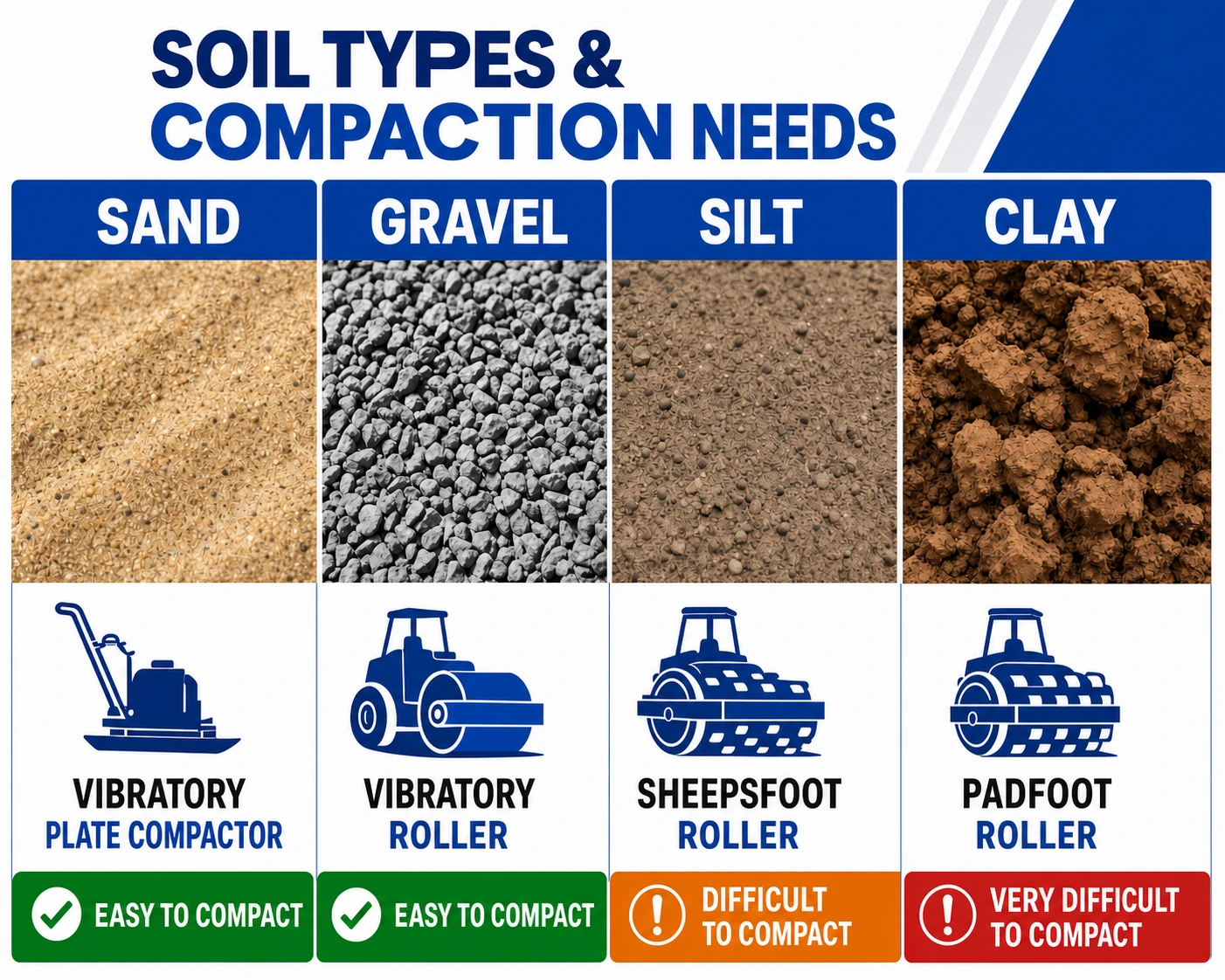
Most commercial sites don’t have uniform soil throughout. Pockets of clay, sand, or fill material all behave differently under compaction from varied equipment, as different soils require different types of rollers. Whereas soils such as gravel and sand can readily yield to the vibrations used in soil compaction, soils such as clay and silt need much more labor-intensive methods.
In addition, the effectiveness of the compaction depends on the proper excavation of construction project and preparation of the site.
What are the Consequences of Poor Soil Compaction?
Poor soil compaction can create serious structural, operational, and financial problems long after construction is complete. From foundation movement to pavement failure and drainage issues, weak soil support can compromise the safety, performance, and lifespan of a commercial property.
Uneven Foundation Settlement
The condition of poor soil compaction creates an uneven subsurface, meaning different sections of the ground respond differently under load. Areas with loosely compacted or higher air-void content compress more under pressure, while denser sections remain relatively stable. Because of this differential stress, cracks form, sloping floors occur, and once tightly fitting doors no longer close!
Cracks and Buckles in Concrete Slabs
A major part of soil compaction problems is that the movement of unstable soils causes concrete to pull away from the ground. Cracks develop, the slab sags, and the structure becomes a danger rather than serving as a durable surface for commercial activity.
Failure of the Drainage System
Water drains differently when the underlying soil is unstable. Instead of flowing where you want it to go, it goes somewhere else or settles in spots where you do not want it. Poor soil conditions are one of the leading reasons underground utility installation requires careful planning on commercial sites.
Pavement and Parking Lot Wear
In commercial spaces, parking lots and access roads take constant traffic. When the base isn’t properly compacted, these surfaces start to deform under repeated use, leading to uneven areas, tire ruts, and a noticeably rough driving surface much sooner than expected.
Legal and Financial Fallout
Structural failures that trace back to poor ground preparation don’t stay quiet. They turn into lawsuits, insurance claims, and reputations that take years to rebuild. The fix always costs more after the fact than it ever would have upfront.
Construction decisions made early in a project carry their own long-term consequences, as outlined in our breakdown of the pros and cons of prefabrication in modern construction!
How to Prevent Poor Soil Compaction?
Preventing poor soil compaction starts with proper testing, planning, equipment selection, and continuous site supervision. By verifying soil conditions and compacting each layer correctly, commercial construction teams can reduce settlement risks and build a stronger foundation for long-term performance.
Have a Soil Test Prior to Starting Work
Prior to using any piece of machinery, a geological survey should have been conducted on the land already. This provides an understanding of the nature of the soil and its moisture content. This will form the basis of planning the process and type of equipment need for soil compaction.
Compact the Soil in Layers
It is recommended that soil be compacted in layers not exceeding a thickness of 6 to 8 inches at one go. Filling a large area in one go will result in loosely compacted soil underneath. Also, make sure the systems beneath the structure are just as solid as the structure itself, including avoiding common failures in commercial gas piping systems.
Test and Verify
Commercial construction typically requires 95-98% compaction of maximum dry density, verified through the Proctor compaction test. To prevent soil compaction problems, regular field density tests are conducted throughout the process.
On-Site Inspection and Supervision
Even if there is an appropriate plan in place, the process may not be successful without sufficient supervision during its implementation. Site inspections are necessary to verify that the lifts, water content, and equipment usage are carried out appropriately.
Conclusion
Soil compaction isn’t the most visible part of a commercial construction project, but it’s easily one of the most consequential. Getting it right the first time takes a team that understands the ground they’re building on!
That’s exactly what Dub-L-EE brings to every commercial project in Albuquerque and across New Mexico. As construction partners, you can count on our experienced team members and their ability to deliver exceptional service!
Need help planning your commercial project? Contact Dub-L-EE today for a free consultation!
FAQs
How deep does soil compaction need to go on a commercial site?
It needs to be at least 3 to 4 feet below foundation level.
Can compaction issues be identified before any visual signs are seen?
Yes, compaction voids can be detected via ground penetrating radar and geotechnical studies before any visual signs are present.
What is a Proctor compaction test, and why is it significant?
It is a lab test that determines your soil’s maximum achievable density: the benchmark all field compaction is measured against.
How can poor compaction of soils affect plumbing or electrical installations inside a building?
Soil movements may cause cracking of the buried pipes or conduits.
What questions do you recommend asking a contractor regarding earthmoving work?
Do they self-perform compaction, their testing protocol, and whether there will be a geotechnical study performed?