
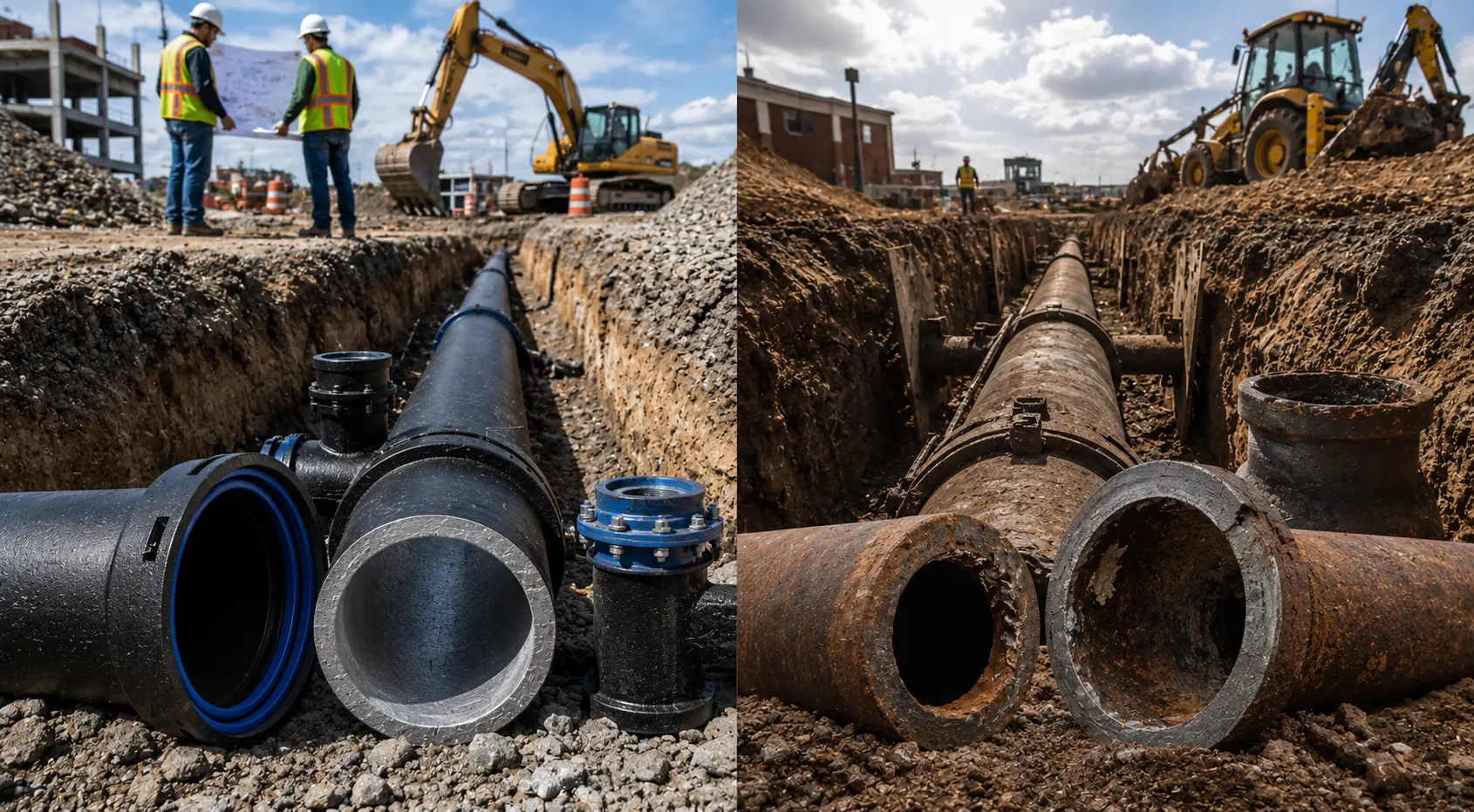
Ductile Iron vs. Cast Iron: Choosing the Right Pipe for Your Commercial Project
If your commercial project involves underground water, wastewater, or fire protection lines, you’ll eventually run into this decision: ductile iron or cast iron? Both are trusted, decades-proven materials, but they behave very differently once they’re in the ground, and picking the wrong one can mean premature failures, costly repairs, or a system that can’t meet your building’s pressure and code requirements.
Pipe failure and corrosion cost the industry billions of dollars a year in repairs and water loss, which is exactly why this isn’t a decision to make based on price alone. Here’s what actually separates these two materials, and what should drive your choice for a commercial application.
Key Considerations for Commercial Pipe SelectionDuctile iron and cast iron offer proven performance, but their suitability depends on specific project conditions. Ductile iron provides greater flexibility, pressure resistance, impact strength, and durability in shifting soils, making it ideal for water, wastewater, and fire protection systems. Cast iron performs well in stable, low-pressure, and above-ground applications. Final selection should consider operating pressure, soil corrosion, ground movement, code compliance, maintenance needs, installation requirements, and total lifecycle cost. |
Ductile Iron vs. Cast Iron: What Actually Separates These Two Materials
Cast iron has been the workhorse of city water, drainage, and sewer systems for well over a century. It’s made by pouring molten iron into molds and letting it cool slowly, which produces thick, heavy pipe walls that hold up well under steady pressure. What it doesn’t handle well is sudden stress: cast iron’s internal structure is made of graphite flakes, which give it strength but also make it prone to cracking under impact or ground movement.
Ductile iron solves that specific weakness. During manufacturing, a small amount of magnesium is added to the molten iron, which reshapes the internal graphite into round nodules instead of flakes. That structural change is what gives ductile iron its name: it can flex slightly under pressure or ground shift instead of cracking, while still handling higher operating pressures than cast iron. That’s why it’s become the standard for drinking water supply, wastewater lines, fire protection systems, and increasingly, commercial gas system networks.
| Not sure which pipe material fits your project? Schedule a Commercial Utility Consultation with Dub-L-EE Contact us |
Why Flexibility Matters More Than It Sounds Like It Should
On paper, “more flexible” might sound like a minor upgrade. In practice, it’s the difference between a pipe that survives soil settlement, seismic activity, and traffic loads, and one that doesn’t. According to the American Society of Civil Engineers, ductile iron pipe’s high-strength, flexible joint system is specifically engineered to move with the ground during earthquakes and other disturbances rather than breaking. In a region with shifting soil or heavy vehicle loads overhead, that flexibility is often the deciding factor, regardless of what a project’s initial budget suggests.
One Mistake We See Property Owners Make
The most common misstep isn’t choosing cast iron when ductile iron was needed, or vice versa. It’s chosen based on upfront material cost alone. Ductile iron typically costs more to purchase, so it’s tempting to default to cast iron to save money on day one. But cast iron’s higher long-term maintenance needs and its lower tolerance for pressure spikes or ground movement can turn that initial savings into a far more expensive repair bill a few years down the line. The real comparison isn’t purchase price; it’s total cost over the system’s service life.
Ductile Iron vs. Cast Iron: A Side-by-Side Look
| Factor | Ductile Iron | Cast Iron |
| Strength under pressure | Handles heavy loads and pressure spikes well | Reliable, but less tolerant of heavy stress |
| Flexibility | Bends slightly under pressure or ground shift without breaking | Rigid; prone to cracking under movement or force |
| Impact resistance | Withstands bumps and sudden force | More likely to crack on impact |
| Underground performance | Tolerates soil movement and traffic loads well | Less tolerant of shifting soil and heavy external loads |
| Long-term maintenance | Rarely needs repair once installed correctly | May require more upkeep as the system ages |
Ductile Iron vs. Cast Iron Pipe for Your Commercial Project: Key Differences at a Glance
Ductile iron and cast iron perform differently under pressure, impact, and ground movement. Ductile iron offers greater flexibility and durability for demanding underground systems. Cast iron is better suited to stable, lower-pressure, and above-ground applications. The right choice should reflect site conditions, maintenance needs, and lifecycle cost.
What Determines the Right Choice for Your Ductile Iron or Cast Iron Project
A handful of project-specific factors should drive this decision far more than a spec sheet comparison alone.
Operating Pressure
As per WERMAC, Every system should be evaluated against its maximum allowable operating pressure (MAOP) before a material is chosen. Ductile iron is manufactured in a range of pressure classes and generally handles high-pressure demands more comfortably, while cast iron is better suited to low-pressure applications.
Soil and Site Conditions
Acidic soil can shorten a pipe’s usable life significantly. Ductile iron is typically wrapped in polyethylene or coated with zinc for added corrosion protection, while cast iron usually isn’t wrapped, which makes site-specific soil testing an important step before installation, not an afterthought.
Seismic and Ground Movement Risk
In areas prone to ground shifting, whether from seismic activity, settlement, or heavy traffic loads, ductile iron’s flexible joint system is generally the safer long-term choice, since it’s built to move with the ground rather than resist it until it cracks.
Fire Protection Requirements
Pipes used in fire suppression or hydrant systems have to meet NFPA 24 guidelines. Ductile iron generally performs better against the sudden pressure surges common in fire suppression systems, while cast iron can still work reliably in smaller buildings where system pressure stays low and consistent.
Why This Isn’t a Decision to Make on Cost Alone
Selecting the wrong pipe material for a commercial application doesn’t just risk an early repair bill. It can mean failed inspections, non-compliance with local building codes, unplanned downtime, and, in the case of fire protection or drinking water systems, real safety consequences. Every project should weigh operating pressure, soil conditions, corrosion risk, expected service life, and local code requirements together, not in isolation.
That’s the kind of evaluation an experienced commercial utility contractor is built to run. At Dub-L-EE, we assess these factors against your project’s actual conditions, not a generic recommendation, so the material you choose is the one that will actually hold up.
| Planning a water, wastewater, or fire protection system for your commercial property? Dub-L-EE has been serving Albuquerque and New Mexico since 2012 with hands-on, code-compliant commercial utility work. Let’s talk about what your project actually needs. |
Frequently Asked Questions: Ductile Iron vs. Cast Iron
What types of joints are available for ductile iron pipes?
Ductile iron pipes can be connected using push-on, mechanical, restrained, or flanged joints, giving contractors flexibility to fit different commercial project requirements.
Can cast iron pipes be used above ground?
Yes. Cast iron is a common choice for above-ground applications like buildings, hospitals, and hotels, largely because it keeps water flow noise low, which matters in quiet or sound-sensitive spaces.
Are ductile iron pipes safe for drinking water systems?
Yes. Ductile iron pipes used for drinking water are typically coated with epoxy on the interior, which prevents direct contact between the water and the iron and keeps the water safe.
Does ductile iron pipe require special handling during installation?
No, ductile iron is actually easier to install in many cases. It’s lighter than it looks and typically uses simple push-on joints, which can reduce both installation time and labor cost.
How does water pressure affect the lifespan of cast iron pipes?
Sustained high pressure can cause internal buildup and wear in cast iron pipes over time, gradually reducing flow and shortening the system’s overall service life.