
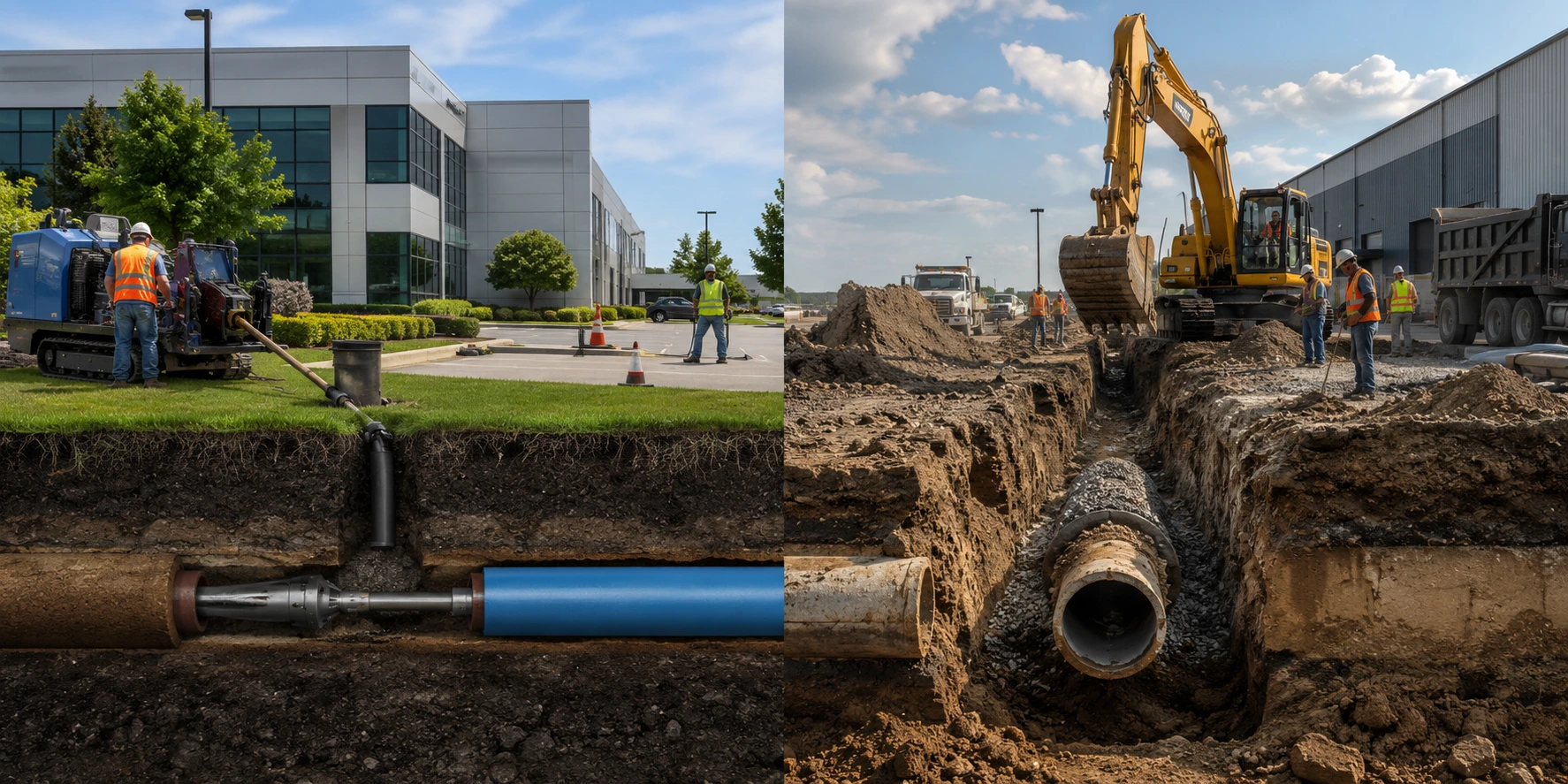
By far, the two most common methods for commercial sewer line repair are pipe bursting and traditional excavation. Well, this is exactly why so many commercial property owners get confused about which one to go for. As they either heard from someone or saw that poor excavation can lead to many issues, such as cracks in sewer pipes, tree root intrusion, foul smell around the property, and slow wastewater drainage throughout the building. Moreover, there is no doubt that both approaches get the job done, but in terms of cost, timeline, and long-term value, they differ a lot. Hence, this blog breaks down pipe bursting vs. traditional excavation methods side by side so that you are aware of which one best fits your situation. Let’s get into it.
Understanding: Commercial Sewer Line Repair MethodsPipe bursting is generally the better option for commercial sewer line replacement when minimizing surface disruption, reducing downtime, and preserving parking lots or landscaping are priorities. Traditional excavation is still necessary for fully collapsed pipes, highly unstable soil conditions, or projects requiring complete infrastructure replacement, making the right choice dependent on pipe condition, property layout, and long-term repair goals. |
What Is Pipe Bursting Technique?
- What it is:
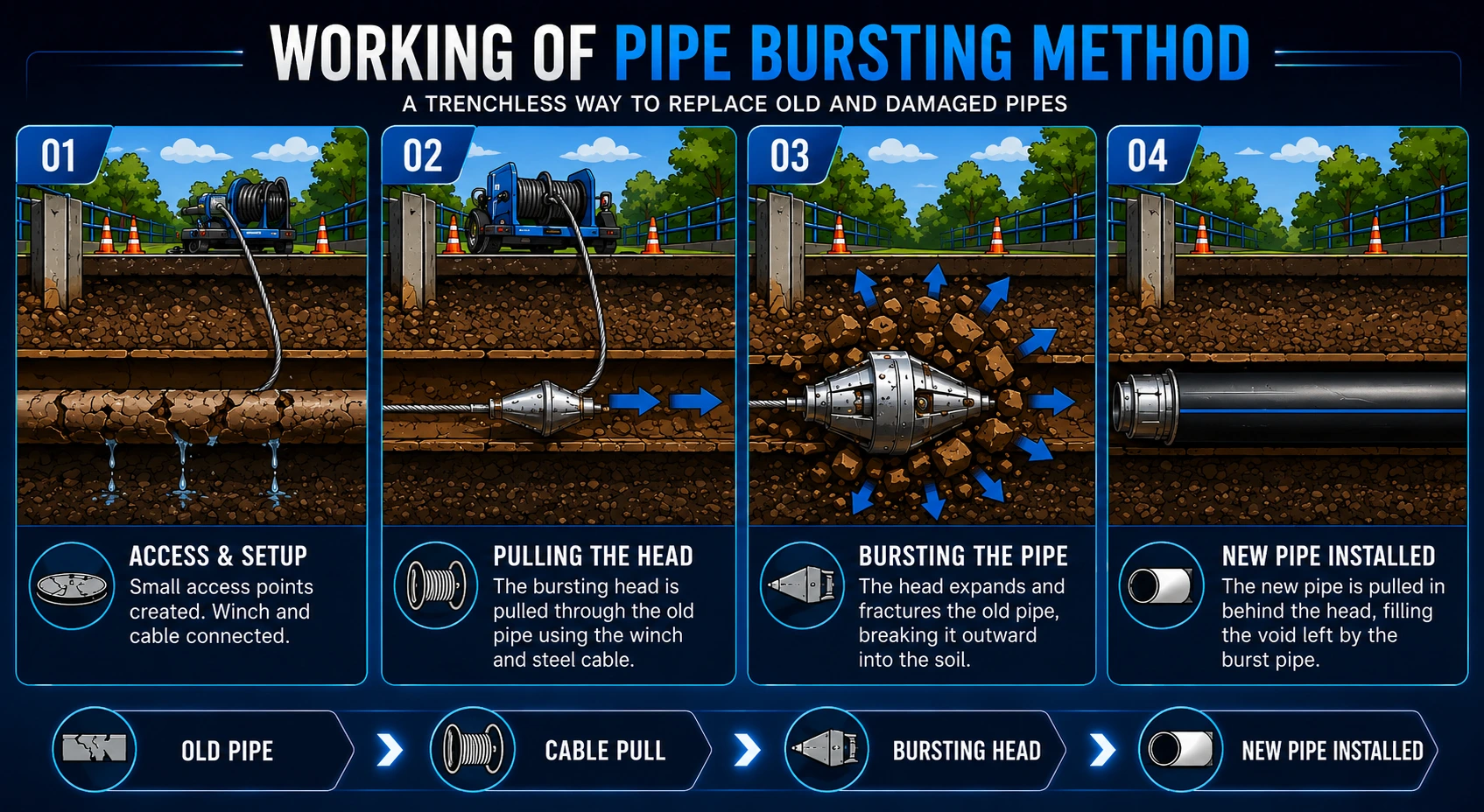
The method of pipe bursting means a trenchless way of replacing damaged underground sewer lines without the need for a full excavation along the pipe’s length. Instead of creating a long trench across your property, the process uses the existing damaged pipe path to install a new pipe underground. Your contractors will only need small access points, such as manholes or small entry pits, which help reduce disruption to the surrounding area, such as landscaping or parking lots.
- How it works:
A hydraulic or pneumatic expansion head is pulled through the existing pipeline via a cable and winch. As it moves, it pushes the old pipe outward until it fractures, while simultaneously pulling the new pipe behind it to immediately fill the void left by the burst pipe. This is important to understand when dealing with congested underground networks, and it is a key reason why underground utility installation is crucial for commercial developments.
What Is Traditional Excavation Technique?
- What it is:
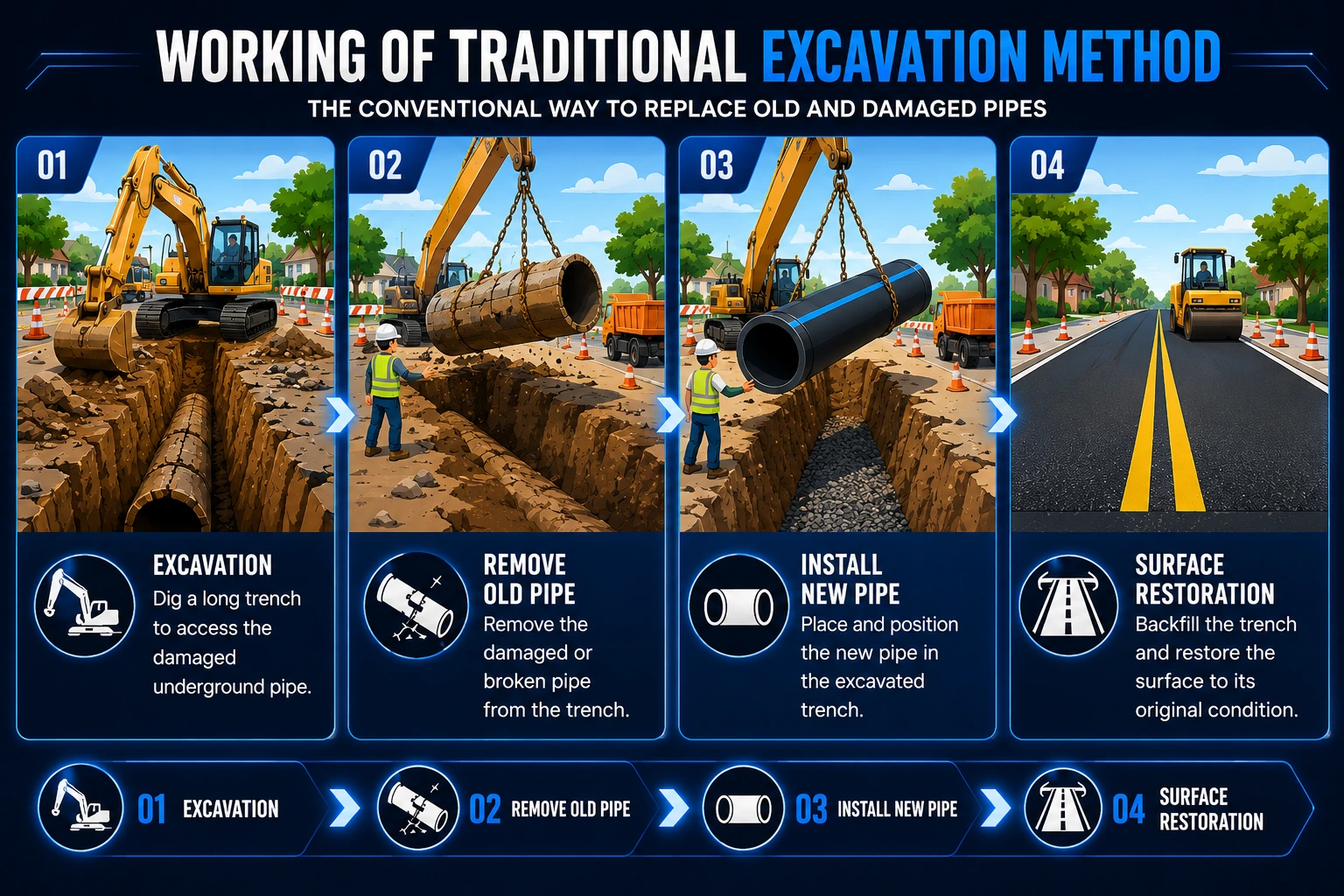
It is also known as open-cut or dig-and-replace. This is the conventional method of repairing or replacing underground sewer lines by physically digging a trench along the full length of the damaged pipe to access and remove it. In this, heavy machinery is also required to break through surface layers, like concrete, asphalt, or soil, before the damaged pipe can even be reached. For commercial properties, that often means tearing up parking lots or driveways, which is exactly why proper excavation is critical, as well as the repair itself.
- How it works:
Under this method, a replacement sewer line is constructed by digging along the entire length of the existing pipeline. Then the old pipe is removed, and a new pipe is installed, requiring extensive surface restoration once the work is complete.
Comparing Pipe Bursting and Traditional Excavation
The common factors between these commercial pipe replacement methods are:
| Factor | Pipe Bursting | Traditional Excavation |
| Surface Disruption | Very little, as only small entry/exit pits are required. | It is extensive, as a full trench has been dug across the property. |
| Project Timeline | Most commercial jobs are completed within a week; many in 1–2 days. | Can take days to weeks, depending on pipe depth and length. |
| Cost | Cuts costs by 30–50% compared to traditional dig-and-replace in many scenarios. | Higher includes excavation, labor, and full site restoration. |
| Pipe Upsizing | You can replace the existing pipe with a similarly sized or larger one to increase hydraulic capacity. | It is possible, but it requires full re-excavation and increases the cost. |
| Disruption to Business Operations | It is low. The minimal surface activity keeps your property functional. | High due to heavy machinery, open trenches, and road/parking closures. |
| Soil Limitations | It is not ideal for densely compacted soils or soils below the water table. | This method works in most soil conditions. |
| Collapsed Pipes | Not suitable if your existing pipe has fully collapsed. | The most preferred method for completely collapsed or severely deformed pipes. |
| Environmental Impact | Less disturbance, economic impact, and environmental degradation than the dig-and-replace method. | Significant ground disturbance and debris disposal required. |
| Best For |
|
|
No matter which method your property calls for, understanding commercial construction risk management is what separates a smooth project from an expensive one!
Conclusion
All you have to do now is quickly make a proper decision before any of the issues escalate into something major. When that decision is made, and you are looking to hire a contractor, Dub-L-EE is the one you should consider. With more than 13 years of experience, we specialize in full-service commercial construction as well as underground utility repairs, giving you quality outcomes across Albuquerque.
Your sewer line won’t fix itself on its own, so let us help you with it. Reach out now!
FAQs
How do I know which method my commercial property needs?
The pipe bursting vs traditional excavation decision starts with a CCTV sewer camera inspection. It will tell the condition of your pipe, blockage type, collapse risk, and the proximity of surrounding utilities before any method is chosen.
Does traditional excavation always cost more than pipe bursting?
Not always. For short, easily accessible pipe sections with no paving overhead, it can act as a more economical option.
Can pipe bursting be used on all commercial pipe materials?
Many materials, like clay, cast iron, and PVC, can be burst. However, HDPE and some reinforced concrete or ductile iron pipes may not be suitable candidates.
During sewer line repair, do I have to shut down my commercial property?
During pipe bursting, you can continue as usual. But in traditional excavation, you may need partial or full shutdowns depending on the trench location and access disruption.
How long does a commercial pipe bursting project usually take?
Generally the commercial pipe bursting projects are completed within one to three days, depending on pipe length and site conditions.