
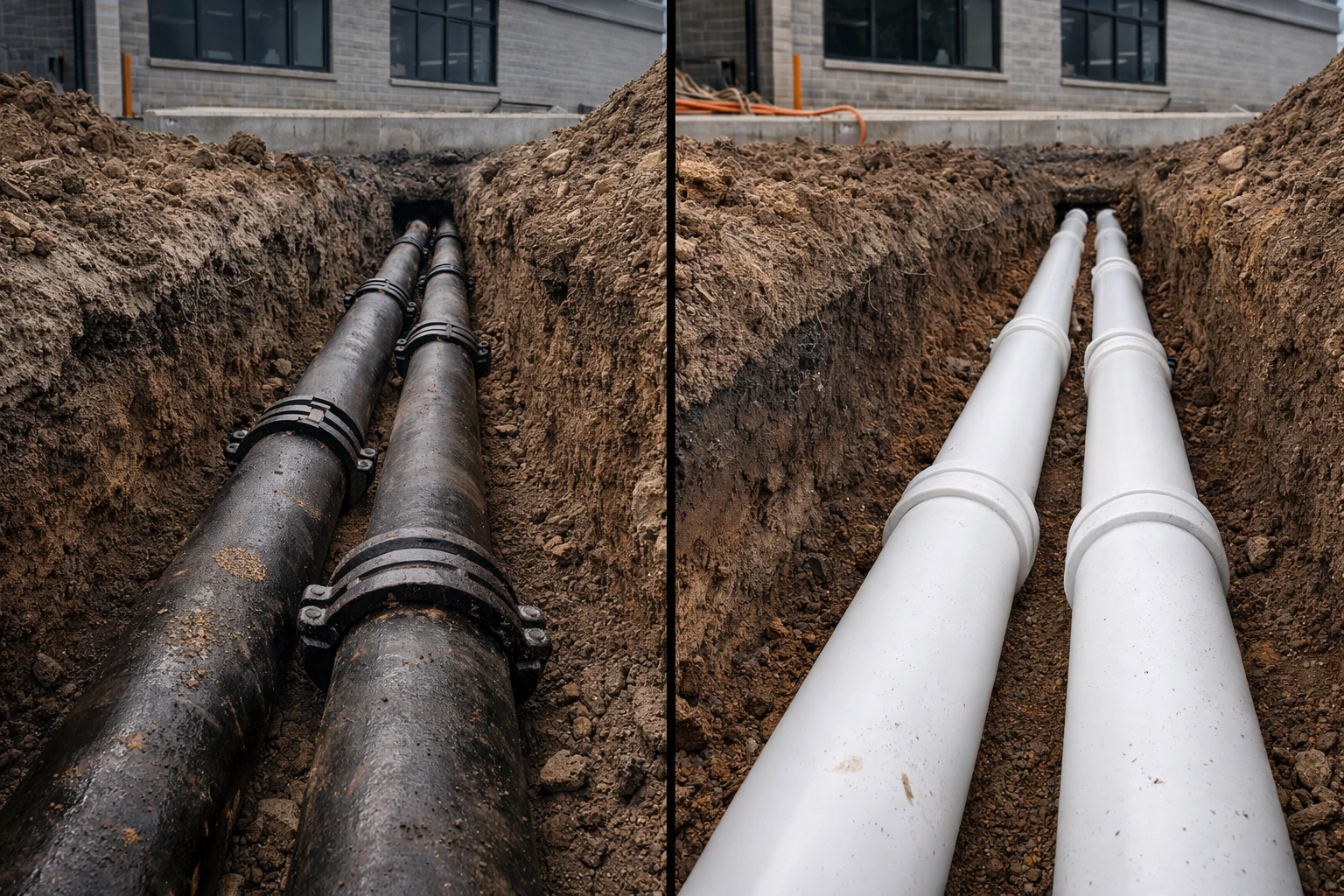
Cast iron or PVC are the two most commonly specified options, each offering distinct advantages depending on soil conditions, load requirements, noise control, and project scope. While one material is valued for its strength and durability, the other is favored for corrosion resistance and installation efficiency. Understanding these differences helps engineers, contractors, and property owners avoid costly repairs, premature failures, and unnecessary maintenance.
Hence, to help you make a confident decision, the sections ahead break down why material choice matters in commercial drainage and outline the key differences between PVC and cast iron, showing exactly where each option performs best and where it may fall short.
Cast Iron Vs PVC Drainage OverviewCommercial underground drainage performance depends heavily on proper pipe material selection. Cast iron and PVC offer distinct advantages based on load demands, corrosion exposure, noise control, temperature tolerance, and installation conditions. Structural strength, lifespan, flow efficiency, maintenance requirements, and code compliance all influence material suitability. Evaluating these factors early helps reduce long-term maintenance risks, prevent system failure, and ensure reliable drainage performance across diverse commercial environments. |
Why Material Choice Matters In Commercial Drainage
The role of technology in modern construction has made it clear that material selection is a defining factor in commercial drainage performance, influencing multiple factors. Let’s check them below:
Durability & Load Resistance
Commercial drainage pipes must withstand constant pressure. Heavy water flow, foot traffic, and equipment weight all push against the system. If the material isn’t strong enough, it will bend or fail. That’s why choosing a tough, load-bearing material is essential.
Corrosion & Chemical Resistance
The drainage systems at many commercial environments regularly encounters detergents, industrial chemicals, and fluctuating pH levels. Some materials react badly to these substances, weakening over time. When you use a corrosion-resistant material, the pipes stay intact longer, maintain smooth flow, and reduce maintenance needs.
Flow Efficiency
When commercial underground drainage pipes have smooth internal surfaces, wastewater moves faster and more consistently. This reduces resistance inside the system, limits debris accumulation, and significantly lowers the chances of blockages, an important factor for reliable performance in commercial facilities.
Compliance & Safety
In the United States, commercial drainage materials must comply with codes such as the International Building Code (IBC), International Plumbing Code (IPC), or the Uniform Plumbing Code (UPC). Approved materials meeting ASTM International and NSF International standards ensure safe wastewater handling, prevent contamination, reduce liability risks, and protect occupants from health hazards, flooding, and structural damage.
Temperature Tolerance
Systems frequently carry high-temperature wastewater from sources such as commercial kitchens, dishwashers, boilers, laundries, and industrial cleaning processes. Repeated exposure to hot discharge can cause low-grade materials to soften, expand, or lose structural integrity, leading to joint failure or pipe deformation. So it’s important to choose materials with high temperature tolerance that can maintain dimensional stability, resist thermal shock, and ensure long-term reliability even under continuous heavy-duty use.
Noise Reduction
In high-flow commercial drainage systems, wastewater movement can generate significant noise due to turbulence, vibration, and impact against pipe walls. The choice of material directly affects how much sound is transmitted through the building structure. Dense or acoustically engineered materials absorb vibration and reduce sound transfer through walls and floors, making them especially important in hotels, hospitals, offices, and multi-story commercial buildings where noise control is critical.
What Are The Key Differences Between Cast Iron Vs PVC Drainage Pipes
Below, we have mentioned the key differences between cast iron vs PVC drainage pipes in detail:
| Comparison Factor | Cast Iron Drainage Pipes | PVC Drainage Pipes |
| Material Composition | Cast iron pipes are made from iron alloys. They are rigid, dense, and robust to sustain heavy loads and external impacts, preventing distortion or deflection. | PVC pipes, produced from polyvinyl chloride plastic, are flexible and lightweight, and can withstand dampness and chemicals, but not physical stress. |
| Structural Strength | It has a high resistance to compressive stress, which is why cast iron can withstand the entire stack of a multi-story building. | PVC is not as impact-resistant and relies on proper support spacings to avoid sagging, particularly in longer horizontal applications. |
| Durability & Lifespan | When maintained, these systems can last several decades to a century, but internal rust and scaling constrain their hydraulic capacity with time. | PVC maintains smooth internal walls throughout its life, offering consistent performance for 40–70 years without corrosion-related deterioration. |
| Noise Control | Steel with a dense metal finish effectively damps vibrations, reducing noise from wastewater movement within walls and ceiling areas. | Plastic construction transfers vibration more easily, making water flow and discharge sounds more noticeable indoors. |
| Corrosion Resistance | Prone to rust, oxidation, and exposure to acidic waste. These can result in pitting and leaks. | Completely corrosion-resistant, unaffected by rust, moisture, or most household and commercial chemicals. |
| Installation Complexity | Requires heavy lifting, cutting tools, couplings, and skilled labor, increasing installation time and effort. | Easily cut, solvent-welded, and assembled for faster installation with less labor. |
| Weight & Handling | Very heavy, requiring additional structural support and careful handling during installation. | These are lightweight. So they reduce strain on building structures and simplify transport and installation. |
| Maintenance Requirements | Periodic inspections are necessary to monitor corrosion, scaling, and joint integrity over time, highlighting the importance of treating sewer line repairs early to prevent material deterioration from affecting overall drainage performance. | Minimal maintenance due to smooth interiors and resistance to buildup and corrosion. |
| Cost Factors | Higher material and labor costs are associated with weight, installation complexity, and the long-term needs for maintenance. | Lower upfront and installation costs make it a cost-effective solution for most projects. |
Best Applications For Each Material
Best Commercial Uses For Cast Iron Drainage Pipes
- High-Rise Commercial Buildings: Ideal for multi-floor structures requiring strong, fire-resistant drainage systems that handle heavy loads.
- Acoustically Sensitive Facilities: Reduces drainage noise in hospitals, hotels, offices, and other occupied commercial spaces.
- Heavy-traffic commercial zones: Can be used in heavy-traffic commercial areas with high parking, loading docks, and other vehicle-accessible zones.
- Legacy Infrastructure & Retrofit Projects: Ensures compatibility with the existing commercial systems for renovation or partial upgrades.
Best Commercial Uses For PVC Drainage Pipes
- Retail, Office Parks, and Commercial Plazas: Suited for long horizontal underground runs serving restrooms and shared commercial utilities.
- Food Service & Light Industrial Facilities: Supports consistent wastewater flow in kitchens, food prep, and light processing operations, where drainage performance must safely coexist with heat-producing equipment and adjacent commercial gas systems used for cooking and process applications.
- Large-Scale Commercial Developments: Allow quicker installations on the vast underground networks of warehouses and facilities.
- New Commercial Construction Projects: Allows flexible system design and efficient routing in modern commercial drainage layouts.
Conclusion
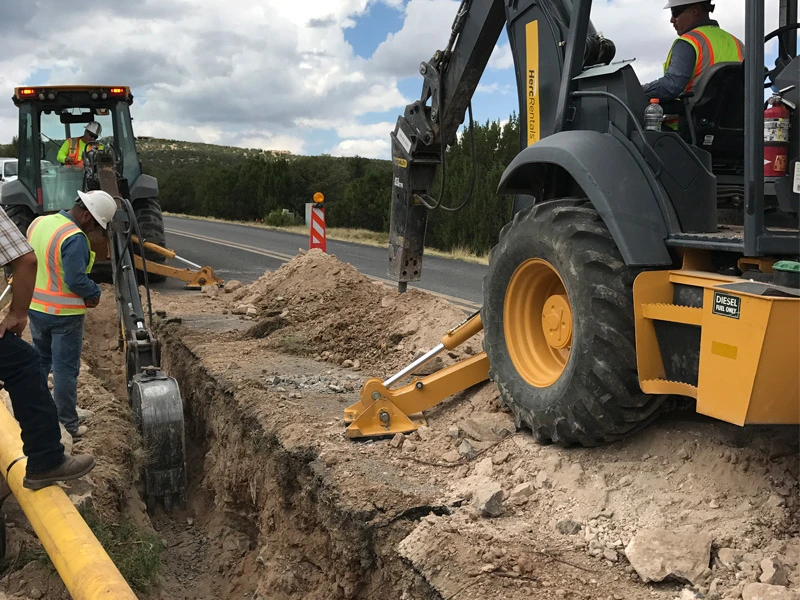
With the guidance above, selecting between cast iron and PVC becomes a more informed decision aligned with a project’s functional and operational needs. Thoughtful material selection during the design stage supports efficient installation, consistent system performance, and reduced disruptions over the life of a commercial facility. When these factors are overlooked, it reinforces why underground utility installation is crucial in new commercial developments. Partnering with experienced professionals such as DUB-L-EE helps evaluate site-specific conditions early, ensuring drainage systems are planned for long-term reliability, compliance, and reduced risk.
FAQ’s
Does Soil Type Affect The Choice Between Cast Iron and PVC Pipes?
Yes, aggressive soils could affect the lifespan of cast iron, and in unstable soils, the techniques of installing reinforced PVC could be required.
How Does Pipe Material Affect the Accuracy of CCTV Inspection and Leak Detection?
The pipe material also determines the visibility and accuracy of leak detection during inspections. In contrast, while cast iron has a more rugged surface topography, its corroded surface can hide joints, defects, and developing leaks.
Are There Differences In Failure Warning Signs Between Cast Iron And PVC Pipes?
Yes. Cast iron usually presents some predictive symptoms of failure in the form of corrosion scaling, leaks, rust staining, or a decrease in flow rate. The PVC usually manifests very minimal predictive symptoms and may fail due to cracking, separation, or deformation under load.
Can Pipe Material Influence Storm water Or Grease Management Compliance?
Material properties of pipes provide compliance as they are related to grease resistance, joint sealing, and sediment growth. These materials include cast iron, which withstands high temperatures and is amenable to impact, and PVC, which is resistant to corrosion and grease adhesion.