
Construction is all about building things like houses, stores, and big factories. But did you know there are different kinds of construction? Some top construction types include residential, commercial, industrial, infrastructure, institutional, and more. Among these, industrial and commercial construction are often considered the same or interchangeable, but in reality, they are not. The two have many key differences; each involves creating facilities for businesses, but the type of business they are targeting differs.
Simply, commercial construction includes building spaces where businesses operate and people visit. On the other hand, industrial construction creates facilities for manufacturing, storage, or processing. So, to make the difference clear and understand each type of construction in a more precise way, let’s dive in and explore commercial vs. industrial construction.
Overview Of General Commercial Vs. Industrial ConstructionCommercial construction creates customer-facing spaces such as offices, retail stores, restaurants, hospitals, and schools, emphasizing accessibility, appearance, and user experience. Industrial construction supports manufacturing, processing, storage, and production through durable materials, specialized layouts, and operational efficiency. Their differences extend to construction methods, zoning, permits, building codes, site selection, project management, costs, and timelines. Understanding these distinctions helps businesses plan facilities that meet functional, regulatory, safety, and operational requirements effectively. |
How Commercial and Industrial Construction Differs
Commercial Construction
Any construction that is meant for selling goods or services is classified as commercial construction. Simply put, it involves the construction of buildings that accommodate commercial institutions. Here are some of the most popular options, but remember, it is certainly not limited to these.
- Retail stores
- Restaurants
- Hospitals
- Shopping malls
- Gyms
- Schools
- Office buildings
Industrial Construction
This construction type builds structures primarily designed for manufacturing and production. Below are some examples:
- Manufacturing facilities
- Factories
- Power plants
- Warehouses
These structures demand careful planning and precise project management to ensure spaces prioritizing safety, functionality, and efficiency, driving industrial progress.
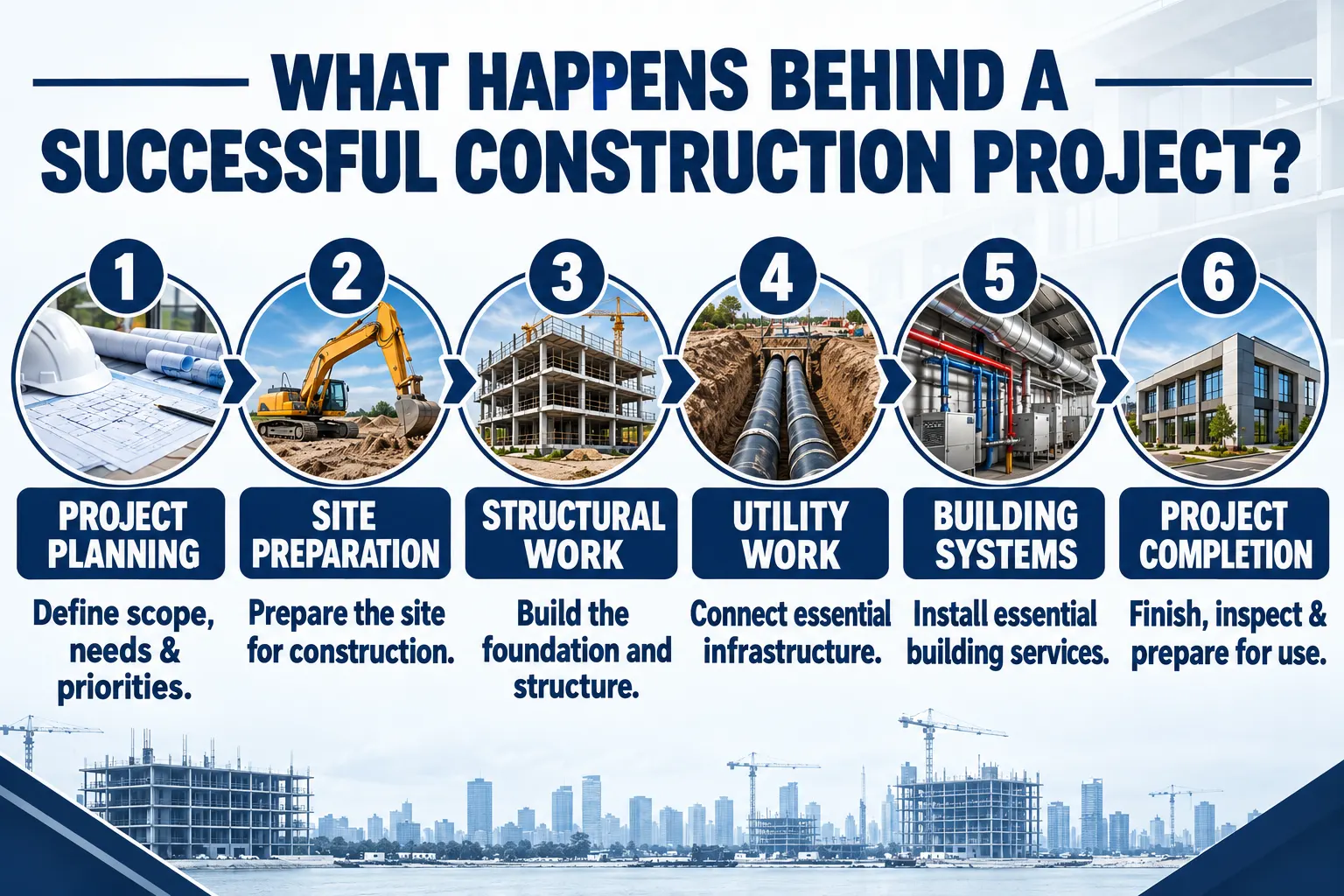
Commercial and Industrial Construction: Key Project Stages
Although commercial and industrial projects differ in purpose, design, and requirements, both involve several core stages that move the project from initial planning to completion. These stages provide a practical view of how construction progresses.
Key Factors that Separate Commercial and Industrial Construction
Building Materials and Construction Methods
Regarding material selection and construction methods, commercial vs. industrial construction differs significantly. Commercial buildings focus on creating attractive designs for a positive customer experience, whereas industrial buildings prioritize functionality and durability. For instance, the materials used for these two types can vary significantly.
Commercial buildings often include:
- Large glass windows
- High-end finishes
- Designer fixtures
Industrial buildings often include:
- Heavy-duty steel beams
- Concrete
- Corrugated metal siding
As for construction methods, commercial buildings usually stick to traditional techniques, while industrial buildings opt for modular construction or prefabrication due to their size and complexity. But remember, construction is always evolving, and modular buildings are at the forefront of new techniques of construction. So, commercial modular construction can also be used to create shopping malls, office workspaces, multi-family dwellings, and more.
|
Need a commercial construction team for your next project? DUB-L-EE provides integrated building, concrete, mechanical, plumbing, and utility services. |
How Commercial and Industrial Construction Differs
Regulatory Compliance
In both construction projects, navigating a complex web of regulations is paramount to ensure safety, quality, and adherence to various standards. Here’s a breakdown of the key regulatory categories:
Zoning
Both commercial and industrial projects are subject to zoning regulations. Zoning dictates the permitted uses of land in a specific area.
Zoning regulations for commercial projects will address factors like:
- Allowed building types: The options range from retail stores to office buildings and hotels.
- Building height and setbacks: These regulations define limitations on building height and proximity to property lines.
- Parking requirements: Zoning dictates the minimum parking spaces needed based on the type and size of the commercial establishment.
- Signage restrictions: Regulations can limit the size, placement, and type of signage allowed on the property.
Zoning for industrial projects focuses on the following:
- Allowed uses: Manufacturing facilities, warehouses, power plants, and other industrial activities.
- Buffer zones: These can be required to separate industrial areas from residential neighborhoods.
- Noise and emission limitations: Regulations might restrict noise levels and emissions generated by industrial activities.
- Storage limitations: Zoning specifies restrictions on the type and amount of materials allowed for storage on the property.
Commercial facilities must also account for accessibility requirements. The 2010 ADA Standards for Accessible Design establish minimum accessibility requirements for newly constructed and altered commercial facilities and public accommodations.
Permits, Inspections, and Licenses
All types of construction require permits, inspections, and potential licenses. However, the specifics differ based on project complexity and potential hazards.
Permits Required for Commercial Construction:
- Building Construction
- Demolition
- Mechanical systems installation (HVAC)
- Signage installation
Permits For Industrial Construction Company Projects Involve:
Similar permits as commercial construction, potentially with stricter requirements due to the nature of the facility.
- Permits for handling hazardous materials.
- Additional permits for specific industrial processes (e.g., power generation in a power plant).
Regular inspections by qualified professionals ensure the project adheres to building codes and safety standards. Both commercial and industrial projects will undergo inspections at various stages of construction. Depending on the specific business or industrial activity, additional licenses are required for operation.
Building Codes
Building codes are a crucial factor that separates commercial and industrial construction. Both sectors adhere to safety regulations, but the specific codes they follow differ based on the building’s purpose and potential risks.
Commercial construction follows the International Building Code (IBC) or similar local codes. The International Building Code provides a foundation for addressing public health, safety, and hazards associated with the built environment.
Industrial construction often falls under the International Code Council’s International Industrial Buildings and Structures Code (IIBC). This code addresses the unique needs of structures such as factories, warehouses, power plants, and other facilities, including:
- Structural strength to support heavy machinery and equipment loads.
- Regulations for safe storage and handling of hazardous materials.
Location Selection
The right location selection is a crucial decision that sets the stage for success in both commercial and industrial construction projects. However, the ideal location for each type of project differs significantly. Commercial construction often seeks locations with high foot traffic, accessibility, and visibility to attract customers, such as downtown areas, areas near residential neighborhoods, or shopping centers.
Conversely, industrial construction prioritizes proximity to transportation hubs, suppliers, and workforce availability, favoring locations near highways, ports, or industrial parks.
Variation In Layout
Both buildings’ construction layouts are tailored to their specific purposes and operational requirements. Let’s learn with examples for a clear idea:
In well-planned commercial buildings, the layout aims to make customers feel welcome and interested. For example, stores often have open spaces and carefully arranged displays to encourage people to look around and buy things on impulse.
Industrial buildings prioritize functionality and efficiency, with layouts optimized for production processes and workflow. For example, manufacturing and industrial construction companies employ a linear or cellular layout to streamline production lines and minimize material handling.
Effective Project Management
The right project management is vital for any construction project’s success, whether commercial or industrial. A clear understanding of the specific focus areas ensures a project is executed with the right priorities in mind.
Commercial Construction:
These projects require careful planning and coordination to meet deadlines, budget constraints, and quality standards while ensuring customer satisfaction. Project managers oversee tasks such as site preparation, procurement of materials, hiring subcontractors, and managing stakeholders to deliver projects on time and within budget.
Industrial Construction:
For industrial building construction, the construction engineering company demands strategic project management to coordinate complex processes, equipment installations, and regulatory compliance. The head of the project can focus on scheduling, resource allocation, safety protocols, and adherence to industry-specific regulations. All of these ensure the timely completion of projects while maintaining safety and quality standards.
Factors such as materials used, labor costs, and project complexity influence the construction budget and timeline for both types of buildings. Understanding these factors is important to ensure efficient and cost-effective construction while meeting necessary standards and regulations. Working with experienced professionals like DUB-L-EE can help navigate these complexities and ensure successful project outcomes.
Whether you are working on a new project or seeking funding for an ongoing venture, a construction loan can be your helping hand in easing your financial burden. To discover more about construction loans and gain insights into how they work. Considering consulting with experts in this industry.
Conclusion
Choosing the right construction partner can make complex commercial projects easier to coordinate from initial planning through completion. DUB-L-EE provides commercial construction, tenant improvements, new building construction, concrete, mechanical, plumbing, and underground utility services, with capabilities that support integrated project execution. Our experienced team works across New Mexico to deliver practical construction solutions aligned with project requirements, quality expectations, schedules, and budgets.
|
If you are planning a new commercial or industrial facility, DUB-L-EE offers construction, utilities, excavation, concrete, and mechanical services throughout New Mexico. So start your new project to bring exceptional value with us. |
Frequently Asked Questions About General Commercial & Industrial Construction
Can a warehouse be considered commercial construction?
Yes, depending on its intended use and classification. Warehouses supporting retail or distribution operations may fall under commercial or industrial categories.
What construction type is best for a distribution business?
Industrial construction is generally better suited when your business requires substantial storage, loading, material handling, inventory movement, and distribution operations.
Should I choose commercial or industrial construction for a mixed-use business facility?
Evaluate which activity occupies the primary facility function, then confirm applicable classification requirements before selecting the project’s construction approach.
Is industrial construction suitable for a business that needs customer-facing space?
Yes. An industrial facility can incorporate offices, reception areas, or customer spaces when these support the property’s primary industrial operations.
Why should businesses determine construction type before starting design?
Establishing the construction category early helps align facility design, operational requirements, engineering decisions, approvals, and budgeting with the intended business use.